
Clever Confidential Ep. 3: Frank Lloyd Wright and the Murders at Taliesin
On the afternoon of August 14th, 1915, fire ripped through Taliesin, the Spring Green, Wisconsin home of the world’s most famous architect, Frank Lloyd Wright. When the smoke cleared seven people would be dead, murdered with an axe at the hands of Julian Carlton, a servant of Wright’s. But why? The motive remains a mystery to this day. But there are so many other questions. Why does seemingly everyone know Frank Lloyd Wright but strangely, very few seem to know this much darker side of his story? In this episode we’ll investigate all of that as well as the great state of Wisconsin, Wright’s never-ending battle with societal norms, and the interplay between critics and creative professionals. Happy Halloween!
On the afternoon of August 15th, 1914, perhaps the world’s most famous architect, Frank Lloyd Wright, was busy in Chicago developing the design of the ill-fated Midway Gardens concert venue and summer garden. Some 200 miles northwest in Spring Green, Wisconsin, Martha Borthwick, a translator, librarian, and Wright’s long-time mistress, was just sitting down to lunch with her two children on the porch of the couple’s country retreat that Wright had dubbed Taliesin, though almost everyone else called it The Love Cottage or Wright’s Love Castle.
-
Mike Wallace: Good evening, what you are about to witness is an unrehearsed, uncensored interview. My name is Mike Wallace; the [cigarette?] is Philip Morris. Tonight we go after the story of one of the most extraordinary men of our time. You see him behind me. He is 88 year old Frank Lloyd Wright, perhaps the greatest architect of the 20th century and in the opinion of some, America's foremost social rebel.
Frank Lloyd Wright: I feel enlarged. I feel enlarged and encouraged, intensified, more powerful. Because why? Because in the one instance you're inspired by nature, in the other instance you're inspired by an artificiality contrary to nature. Am I clear?
Wallace: You are clear, although I must say that I don't agree because whatever inspires...
Wright: We do historically give ourselves away. Somebody said the museum out here on 5th Avenue looked like a washing machine.
Wallace: And that's one of your buildings?
Wright: That's one of my buildings. But, I've heard a lot of that type of reaction and I've always discounted it as worthless, and I think it is.
Wallace: I understand that last week, in all seriousness, you said, “If I had another 15 years to work I could rebuild this entire country, I could change the nation.”
Wright: I did say that. That is true.
Amy Devers: On the afternoon of August 16th 1914 perhaps the world's most famous architect, Frank Lloyd Wright, was busy in Chicago developing the design of the ill-fated Midway Gardens concert venue and summer garden. Some 200 miles north west in Spring Green, Wisconsin Martha Borthwick, a translator, librarian, and Wright's long-time mistress, was just sitting down to lunch with her two children on the porch of the couple's country retreat that Wright had dubbed, 'Taliesin'. Though almost everyone else called it 'The Love Cottage' or 'Wright's Love Castle.”
Wright had met Borthwick who everyone called “Mamah” a decade earlier when she and her then husband Edwin Chaney had hired Wright who also happened to be their neighbor, to design a new home for them. Wright was immediately taken with Chaney's wife and set about wooing her. The couple developed what was referred to by outside observers as an 'open closeness,' and what insiders called a 'deep and deeply scandalous love'.
Wright was married with six children at that time, Borthwick had two. Wright, 47 years old and already considered one of America's greatest architects, was a sought-after media darling. He could always be counted on for a controversial quote that would sell papers. He had almost single-handedly created American modernism and was perhaps the single biggest critic of American moralism.
Wright famously decreed that there was one set of societal rules for the ordinary person, and another set of rules which in Wright's parlance really meant no rules for intellectual heavy-weights, or as he liked to say, 'geniuses'. And in his mind and many others, he very squarely sat in the rarefied corner of the latter.
Wright's notoriety obviously did not help the couple's attempts at a hush-hush affair. They first fled to Europe in 1909 to escape the glaring lights, prying eyes, and general scorn being heaped upon them from all sides. On this trip Mamah and her husband officially divorced, but Wright's wife Katherine, refused. Leaving Wright's critics seething. Despite the six children he and Katherine shared and Katherine's refusal to grant a divorce, Wright effectively checked out of his family's life.
Upon Wright and Mamah's return to the States, Wright purchased property in Spring Green, Wisconsin and set about building a fantastic mansion which he could called “Taliesin' or 'Shining Brow' in Welsh, where Mamah and her children could escape the ridicule of the press and neighbors and she and Wright could enjoy their torrid and now very public affair. The peace and tranquillity would not last long. One grizzly summer afternoon two years after moving to Spring Green, Wright and Mamah's world would very literally go up in flames.
I'm Amy Devers, and this is [0.05.00] Clever Confidential where we dig into the lessor told stories of the darker side of design, the shadowy, sometimes sordid tales hiding under a glossy top coat of respectable legacy. This is Episode Three: Frank Lloyd Wright and the murders at Taliesin. As always, here to help me tell this truly shocking tale, is writer and editor Andrew Wagner.
Andrew Wagner: Mamah and her two children, John 12, and Martha eight, were sitting down to lunch at Taliesin East in Spring Green on that summer afternoon. Taliesin was a hive of activity as it generally was, with many of Wright's gardeners, draftsmen, carpenters, and colleagues running about working on far-flung projects as well as Taliesin itself. As was common at the time, Taliesin also employed a number of servants including a recent hire from Barbados, Julian Carlton.
As Mamah and her children sat down to lunch on the front porch, 25 feet away the workers ate their soup at another table when suddenly a 19 year old draftsman, Herbert Fritz, noticed something unusual. “We heard a swish as though water was thrown through the screen door,” Fritz would later recall. “Then we saw some fluid coming under the door. It looked like dishwater. It spread out all over the floor.”
Carlton had just served lunch to Mamah and her children when he turned to his wife. Gertrude, also a servant of Wright's, and instructed her to leave. He then returned to the porch with a hatchet and brutally attacked Mamah and the kids. When he finished his unbelievable act of cruelty on the porch, he quickly dowsed the floors with gasoline, the dishwater-like liquid Fritz had noticed whilst slamming the door, locking it, and sending the whole house into flames.
In the frenzy that followed draftsman Emile Brodelle, handyman Thomas Bunker, and Earnest Weston, the son of Wright's carpenter and master craftsman William Weston, would meet the same gristly fate as Mamah and her children. While it is safe to assume there could be no fate worse than being engulfed by flames, the five unlucky souls that frantically fled for their lives that afternoon would meet an end just as fatal.
Waiting on the porch, axe in hand, Carlton made quick work of each individual as they unwittingly jumped from one horrible end to another. Carlton swung his axe in frenetic fashion as his former colleagues broke through the barricaded door or jumped from a nearby window into the courtyard.
Fritz, the 19 year old draftsman, had managed to escape the burning house and by rolling down a nearby hill, put out the flames that had consumed his hair and clothes, only to look back and witness Carlton's continued attacks. Earnest Weston, the master craftsman who had built Taliesin, and gardener David Lindblom, would also manage to escape and run more than a half a mile to the nearest house with a telephone, quickly alerting authorities to the atrocity.
As residents and police ran to the scene, they found the bodies of Mamah, Martha her daughter, John her son, Earnest Weston, Thomas Bunker, and Emile Brodelle. Lindblom, the gardener who had escaped, would later die due to complications from burns. In the span of 20 minutes, seven people had died tragically at the hands of one man. But, why?
Carlton was found in the basement hours later, barely conscious after having swallowed Muriatic acid. He would die seven week later from starvation having never provided a motive for the horror he inflicted that day.
His wife would later say that he seemed to be suffering from a mental break in the weeks leading up to the attacks, while some of his colleagues at Taliesin would claim that he had been the recipient of racial slurs in the preceding days, possibly inciting an incendiary rage. Still others have claimed that Mamah had told Carlton and his wife that they were to be fired, perhaps even that afternoon. Though the brutal crime was an open and shut case, the motive remains a mystery to this day.
Wright: That's one of my buildings. But, I've heard a lot of that type of reaction and I've always discounted it as worthless, and I think it is. I think any man who really has faith in himself will be dubbed arrogant by his fellows. I think that's what happened to me. [0.10.00]
Amy: This story is the one that got Clever Confidential started. We were curious as to why more people didn't know about it. While everyone knows Frank Lloyd Wright, how could it be that this gruesome chapter remains under reported? Was it Wright's own seeming unwillingness to confront the demons of this tragedy? Did he court disaster with his flagrant flaunting of moral norms?
Wright is famously quoted as saying, “Laws and rules are made for the average. The ordinary man cannot live without rules to guide his conduct. It is infinitely more difficult to live without rules. But, that is what the really honest, sincere, thinking man is compelled to do.”
We wanted to know how this and other tragedies surrounding America's greatest architect affected the man and even the architecture itself. We wanted to know how Wright's beloved home State of Wisconsin shaped him in this event and subsequently how this event has shaped Wisconsin. How is it perceived in Wisconsin versus the rest of the world? Did the rest of the world turn a blind eye to the architect's seemingly sociopathic tendencies because they were so enamoured of the architectural genius?
To help us gain some cultural context we asked Chicago based architect Brad Lynch, himself a Wisconsinite like Wright, to help us paint a picture of the place, the profession, and the sometimes twisted, sometimes tragic nature of creative professions.
Brad Lynch: My name is Brad Lynch. I'm in Chicago, Illinois, and I'm the Founding Principal of the architecture and design firm Brininstool + Lynch. I was born in Racine, Wisconsin, the youngest of five children. I was the only one born in the United States. My dad is from Ottawa, Ontario and my mom is from New York. They moved to Racine, Wisconsin just before I was born and I grew up there until I went away to school. I lived just a couple of doors down from a Frank Lloyd Wright house.
I think that the aesthetic that he developed which was his own, it certainly, like all things, was influenced. You can't say that he started from scratch and just came up with these ideas, but he did make them his own. He made them his own in terms of design and capability and talent, but he always had to have a story behind it in order to sell it. First of all you have got to remember the general public only knows two names of architects in America.
Amy: Right. Well, yeah. Wright is one of them. (Laughter)
Brad: Wright is one of them and the other one is Thomas Jefferson, and the only reason they know his name is because he was President. The other thing is that architects, you can't get away from a major influence like Frank Lloyd Wright. You can say that Wright had nothing to do with your work, but I would challenge anybody that is doing contemporary modern work that doesn't have some love of Wright's work.
I would say that for me, I spend a lot of time not wanting to have influence from Frank Lloyd Wright, but I can't do anything about it. Even the days of Taliesin in terms of people coming there to work as apprentices, they were coming from all over the world. Even back in the 20s he had a worldwide reputation as an important figure in architecture. He's just all around, you can't get away from him. Then as I grew older and I heard stories and so forth about some of the things that he had done.
Wisconsin has a very interesting and unique history. More so than a lot of other States, and it was a very progressive State. It was the first State that had a welfare system. It was the first State that had a university system or the Wisconsin idea where you could go to any college or university within 70 miles of you. It was the 33rd largest State and it had the third largest university system.
Andrew: Wow.
Brad: It was the birthplace of public radio and public television. It was just a very progressive, liberal State. It was the birthplace of the Republican party and there was the progress of weighing of the Republican party which was kind of run by this family called Little [Fallids 0.14.43] and they promoted the Wisconsin idea in terms of education, in terms of resources, and in terms of the ability to get services from the State. [0.15.00]
Wisconsin had, like I said, one of the first welfare systems which was actually developed by Republicans and Republicans were the conservationists, so it kind of tells you how things have flipped around. Most of these ideas came from German and Scandinavian transcendentalists who settled in the area. Milwaukee had a Socialist mayor until, I believe, the 60s. From like the 20s till the 60s, something like that.
So, it was a State that was very interested in hard work and a beautiful State in terms of landscape and property, and I think Wright loved it. He loved he fact that his forebears and uncles were farmers and that they still read at night and could wear a bow tie when they went out on a horse with a plough. There was all these cultural aspects that were unique to Wisconsin.
I didn't know about the fires at Taliesin and the murders until I was probably in my 20s. That particular story I wasn't really aware of until I was older and doing more studying. During my lifetime there was a lot of people that met Wright that were still alive, and they all had something to complain about. (Laughter) It was the rough slate, he was a charlatan. He would drive into a gas station and fill up his gas and then drive off and say, “I'm Frank Lloyd Wright.” (Laughter) There was just countless stories.
When Mrs. Wright died in Arizona, in her will, I don't know how this happened, but she in her will had Wright's body dug up at the cemetery in Spring Green in the middle of the night, cremated, and then sent down to be set next to her in Arizona. That was kind of a big story.
My brother-in-law who used to be the DA up in Radisson, he was driving me out there to this farmhouse and he was just so mad about the [** 0.17.34] he said, “Boy, if I still was in prosecutor, I would have gone after that. I never would have let that happen.” And I go, “Well Jim, I thought you thought Frank Lloyd Wright was an asshole.” And he goes, “Yeah, but he was our asshole.” (Laughter)
I just don't know anybody that I've ever met in regards to a client that wasn't in a fight with him, but even the Kaufmanns that he had so much trouble with Fallingwater and so forth, they wouldn't even say a bad word about him. They called him Mr Wright and they believed in his work and they believed in what they accomplished for him, even though some of it didn't work correctly, functionally and it didn't keep out the rain necessarily in some instances, but they still liked him. Same with the apprentices. I don't know how you balance that.
You've probably heard this story, but this is the one that I know, hearing from the daughters that Herbert Johnson's nickname was Hib. So, the first dinner party they had, he had designed this dining table that is ridiculous. It's still there if you ever go to [** 0.18.52] but the table slides into the kitchen and it's a very long, long table. It slides into the kitchen, they load the food on the table, and then it slides back out. (Laughter)
There's an opening above the table that you pull back these shutters and you come back and the table comes out. It was pouring rain, first big dinner that he's having in the house with supposedly a lot of important there. He's sitting at the end of the table, he's bald, and the next thing you know there's water dripping right on his bald head. (Laughter) This is actually a true story. (Laughs)
The phone is behind him, he picks up the phone, gets the operator and says, “Give me Frank Lloyd Wright in Tucson, Arizona.” Back in those days that's how you made a call. So, he gets Wright on the line and he goes, “I'm sitting here having dinner with a group [0.20.00] of my friends and it's pouring rain on my head.” Wrights response was, “Move your chair, Hib.” (Laughter)
Amy: I don't think having tragedy in your life makes you unlikeable.
Brad: I don't either. I think tragic events to somebody who is a creative, only makes them more determined in terms of their work.
Amy: That's interesting to think about how it may have galvanized his resolve, maybe even made him come face to face with his own mortality and then resolve to achieve even more before that happens.\
Brad: He certainly was concerned with his legacy, there's no question.
Amy: Yeah.
Brad: And I think he was also concerned what people's perception of him was in regard to his legacy. I think that had a lot to do with the stories that he did make up because he wanted to be thought of in a certain way. Deep down I'm sure he was very insecure and a lot of the things that he did were to give his way of life and his approach to life some meaning.
One of the... I can't remember who wrote about this, but when his first wife died before he did, he was actually very grief stricken and depressed in his last couple of years because that was the beginning of his life and he was reaching the end of his. There's so many different tragedies in stories that surround that, it's like where do you begin. For someone that has the perseverance to move on from those, people are intrigued by those stories, but I don't know what that really has to do with his work.
Amy: I can tell you why I'm intrigued and what I think it has to do with his work. I don't know that it influenced his architecture, but I think we've immortalized him by calling him a genius, and in doing so, we've oversimplified him to be this inaccessible, gifted, singly-faceted person.
But, when you become aware of the richness of his life, some of it marked by tragedy, you start to think of him more as a human. And when you start to think of him more as a human, then his work becomes even that much richer because he wasn't beamed from outer space, he's a real person who, against a lot of odds, was able to transcend boundaries of exiting architecture.
Then I also think when we revere him as an architect and celebrate him as a human who also had a full life with the full spectrum of emotion and tragedy and consequence, then it becomes less inaccessible for future architects to attempt something like that. I think it's really important to talk about people as full humans.
Brad: Yeah, it's interesting. Perhaps this is a Frank Lloyd Wright thing, was he is sort of caught in that middle and a lot of people are, I think, between being an artist and being an architect. An artist is granted a lot more leeway in terms of doing what they want to do because an artist is supposed to be singular, and architecture and design is much more about collaboration. But, if you're an artist who is doing architecture I could see how you could run into some challenges.
Amy: I feel like the work is even that much more interesting when you know the context under which it was created.
Brad: Oh yeah.
Amy: Dealing with this intense insecurity, this public criticism of his lifestyle, this tragedy that he almost had to brush under the rug because if he gave the public any inch, they would have taken a mile in terms of condemning his lifestyle. I think they even said the 'angle of vengeance' or somebody was responsible for this. So, he almost had to make it go away so he could continue doing his work. But, now, in terms of investigating his legacy, I don't think we do him or ourselves any favors [0.25.00] by immortalizing him and mythologizing him as some sort of inhuman genius.
Brad: To me it feels like you can't separate the two. His work is his life and you can't separate it.
Amy: Yeah, it's not like he clocked out at 17:00.
Brad: Right, yeah. Exactly. So, like you said, it adds this real richness when you start to see the totality of the person responsible for bringing this work to life.
Wallace: Do you believe in your personal immortality?
Wright: Yes. You get so far as I am immortal. I will be immortal. To me, young has no meaning, it's something you can do nothing about. Nothing at all. But, youth is a quality, and if you have it, you never lose it. And when they put you into the box, that's your immortality.
Amy: Could Wright's tendencies to ignore the negative have played a role in the tragedy at Taliesin? Could the tendency to ignore or to try to ignore the challenges simmering below the surface lead to an explosion, murders in this case, in one form or another?
Rather than confronting the problems head on and putting out fires both literal and figurative before they become tragic, Wright seemed to ignore any and all criticism and do what he believed was right. Could this have exacerbated the problems brewing at Taliesin? Could FLW or anyone have seen the murderous tendencies of Julian Carlton if they had chosen to?
Creative people are so often pushed into adversarial relationships with critics. They are told to ignore bad press and plough ahead, but is there another way to exist in relation to critics and criticism? A way to not let the critics crush you as a creative, but to embrace it and use the criticism to get better and be better? Might understanding life, with all its inconsistencies and tragedies, as well as its triumphs, point us to a more meaningful relationship with, and a deeper understanding of not just ourselves, but others? We think so.
Thanks for listening to Clever Confidential. To see images and more, head to cleverpodcast.com. For our next episode we'll be delving into the story of Italian design legend Olivetti and all of the international mysteries and scandals surrounding the race to create the world's first desktop computer.
If you like Clever Confidential and want to hear more, please support us by telling your friends and letting us know what you think. You can find us on Twitter, Instagram, and Facebook #CleverPodcast. Thank you to Brand Lunch of Brininstool + Lynch architects for lending his expertise, insight, and colorful commentary.
Clever Confidential is produced by 2VDE Media. Camille Stennis lended her audio wizardry for editing and sound design. Ilana Nevins did some heavy lifting production assistance. Our huge thanks to both. Our theme music is Astronomy by Thin White Rope from their album In the Spanish Cave courtesy of Frontier Records. Thanks to the Harry Ransom Center at the University of Texas for the clip of Mike Wallace interviewing Frank Lloyd Wright.
Clever is part of the Airwave Media Podcast Network. Visit airwavemedia.com to discover more great shows. They curate the best of 'em so you don't have to.
Wright: I think the common man is responsible for the drift toward conformity now. It is going to ruin our democracy and it is not according to our democratic faith. And I believe what you call the common man is what I call the common man, a man who believes in nothing he can't see, and he can't see anything he can't put his hand on.

Frank Lloyd Wright, Credit: Al Ravenna, New York World-Telegram and the Sun staff photographer, via Wikimedia Commons
Wright had met Borthwick, who everyone called Mamah (“Maymah”), a decade earlier when she and her then husband, Edwin Cheney, had hired Wright — who also happened to be their neighbor — to design a new home for them. Wright was immediately taken with Cheney’s wife and set about wooing her. The couple developed what was referred to by outside observers as an “open closeness” and what insiders called a deep — and deeply scandalous — love. Wright was married with six children at the time. Borthwick had two.
Wright, 47 years old and already considered one of America’s greatest architects, was a sought after media darling. He could always be counted on for a controversial quote that would sell papers. He had almost single-handedly created American Modernism and was perhaps the single biggest critic of American Moralism. Wright famously decreed that there was one set of societal rules for the “ordinary” person and another set of rules — which in Wright’s parlance really meant no rules. — for intellectual heavy-weights, or as he liked to say, “geniuses.” And in his mind (and many others’) he very squarely sat in the rarified corner of the latter.

Taliesin, Credit: Edward Stojakovic via Flickr
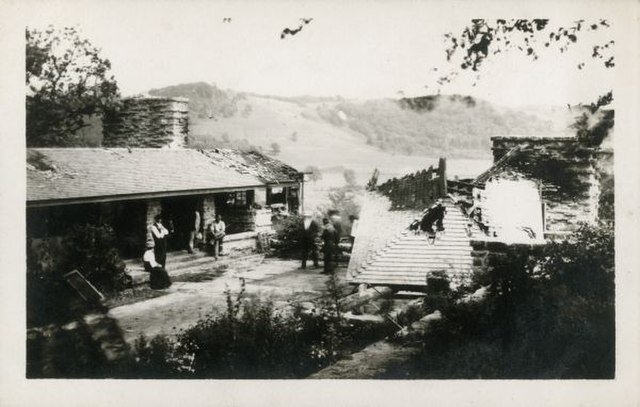
Taliesin After Fire, Credit: Albert Rockwell via Wikimedia
Wright’s notoriety obviously did not help the couple’s attempts at a hush hush affair. They first fled to Europe in 1909 to escape the glaring lights, prying eyes, and general scorn being heaped upon them from all sides. On this trip, Mamah and her husband officially divorced, but Wright’s wife, Catherine, refused, leaving Wright’s critics seething. Despite the six children he and Catherine shared, and Catherine’s refusal to grant a divorce, Wright effectively checked out of his family’s life.
Upon Wright and Mamah’s return to the States, Wright purchased property in Spring Green, Wisconsin and set about building a fantastic mansion which he would call Taliesin — or Shining Brow in Welsh — where Mamah and her children could escape the ridicule of the press and neighbors, and she and Wright could enjoy their torrid, and now very public, affair.
The peace and tranquility would not last long. One grisly summer afternoon, two years after moving to Spring Green, Wright and Mamah’s world would very literally go up in flames.

The terrible fate of Mamah Borthwick in her bungalow of love, Credit: The Ogden Standard via Wikimedia

Brad Lynch
Join hosts Amy Devers and Andrew Wagner along with special guest, Chicago architect, Brad Lynch, as we explore this tragic — and tragically underreported — event that really gave birth to this podcast. We wanted to know why seemingly everyone knows Frank Lloyd Wright but strangely, very few seem to know this much darker side of his story. In this episode we’ll investigate all of that as well as the great state of Wisconsin, Wright’s never-ending battle with societal norms, and the interplay between critics and creative professionals.
Click here to donate to Clever so we can keep this series going!
There are many more stories like this that need to be told, including the Taliesin Axe Murders and Louis Kahn’s Untimely Demise in New York City’s squalid Penn Station.
We are excited to make Clever Confidential a series but we need to hear from you! Please drop us a line via social media (@cleverpodcast), or via email hello@cleverpodcast.com. Tell us what you like. What you don’t. And what other stories we should pursue. We can’t wait to work with you, our amazing listeners, to make the stories on Clever Confidential… not so confidential.
Credits:
Hosts: Amy Devers & Andrew Wagner
Writing and research: Amy Devers & Andrew Wagner
Guest: Brad Lynch of Brininstool & Lynch Architects
Production Assistance: Ilana Nevins
Editing and Sound Design: Camille Stennis
Theme Music: “Astronomy” by Thin White Rope courtesy of Frontier Records
Logo design: Laura Jaramillo
Keep Listening


