Ep. 13: Tanya Aguiñiga
Mexican and American artist/designer/maker/activist Tanya Aguiñiga shares what it was like growing up in Tijuana and crossing the US border every day to attend school in the US, how an accidental haircut during her troubled teenage years got her kicked out of the house, and how a dedicated mentor gave her the encouragement she needed to become an artist. She also recounts a few crazy stories featuring a clown, a bull and an eagle.
Jaime Derringer: Clever is supported by Rhode Island School of Design, whose unique culture of critical making combines studio-based learning with liberal arts studies, preparing artists and designers to be creative leaders in their fields. Find out more about RISD's undergraduate and graduate programs at risd.edu
Tanya Aguiniga : I just hope I gave enough and there was still enough, like, like, entertainment.
Amy Devers: Yes, there was plenty of entertainment. Right? Plenty of entertainment. So much that we're gonna have trouble editing out the good stuff
Jaime Derringer: Hi, everyone, I'm Jamie.
Amy Devers: And I'm Amy, and this is Clever. Today, we're talking to Tanya Aguiñiga. Tanya's an artist, craftsperson, designer, and activist. She grew up in Tijuana, Mexico, and spent her childhood crossing the US-Mexico border every single day to attend school in the US. So this Mexican American dual identity informs both her work and her personality. Her work is primarily textile-based and handcrafted, and her design work includes furniture, wearable accessories, and home decor pieces.
Jaime Derringer: You may have seen some of her dip-dyed rope bracelets on chic celebrities, or maybe you just saw them on me and Amy 'cause we have some. Some of her felted folding chairs and other furniture in design magazines, and some of her more elaborate weavings and wall hangings in uber trendy hotels like the Ace in LA or the American Trade Hotel in Panama.
As a craft-based fine artist and activist, she creates compelling installations and activations using craft as a performative medium to foster community, as well as generate dialogues around identity, culture, and gender.
Amy Devers: She studied furniture design at San Diego State University, and then got her master's in furniture design from the Rhode Island School of Design.
She's a United States Artist Target Fellow, a Creative Capital 2016 Grant awardee, and has been featured in PBS's Craft in America series. More importantly, she's a very, very dear friend of mine, and I love her like a sister. She's super smart, super colorful, and super badass. Just wait till you hear her story.
Tanya Aguiniga : My name is Tanya Aguiniga, and I live in Los Angeles, and I am originally from Tijuana, Mexico, otherwise known as Tijuana In English by many folks. I guess I am a designer, maker, artist activist. Yeah, and on the design end it would be textiles, furniture, and jewelry, and accessories for the home and self. And I'm also an art teacher, and also an educator.
Amy Devers: Wow, that's a lot. Mm-hmm.
Tanya Aguiniga : And a mama.
Amy Devers: And a mama. Yeah. Let's not forget that. Yeah. Aio is super cute.
Jaime Derringer: Super cute.
Amy Devers: Okay. So you're a dear friend of mine, so I know a lot of these answers already, but you have to tell our listeners all about you. Okay. So let's start from the very, very beginning.
Tanya Aguiniga : Okay.
Amy Devers: Where did you grow up, and what was your childhood like?
Tanya Aguiniga : So I grew up in Tijuana, and I guess now I would be, like, third generation from Tijuana. And I grew up living in Mexico but going to school in the US, so I would cross the border every day for 14 years to go to school in the US every single day, and my parents did it for close to 40 years. And so that made me kind of an odd little babe.
Amy Devers: Yeah. Now, were you out in the open about living in Tijuana, or did you have to have a fake address in the US so you could go to school there?
Tanya Aguiniga : Um, you have to be pretty, like, like, on the down low about it. And so then I had to use my grandma's address, and then when my grandma passed away I had to use my aunt's address, my best friend's address, my best friend's grandmother's address, and different aunts and stuff.
Amy Devers: Did you feel a little bit, like, 'cause you had to keep your kinda life on the down low, did you feel like a fugitive? Or what did you feel like?
Tanya Aguiniga : Not like a fugitive, but definitely there was a, like, a massive stigma to, like, living in Mexico. It's, it's kind of gone through, like, different iterations of, like, stigmatization. But when I was a little kid everybody thought Mexico was, like, dirty place that was just full of, like, poverty and, like, little caves where people, like, lived in, like, cardboard shacks. And then when I got a little bit older, then everybody was like, "Oh, that's where all the, like, bad drug stuff is going on, so, like, you can't go into Mexico," or, like, "Oh, you're gonna get kidnapped." So there's been, like, a bunch of different, like, ways that people have, like, hated where I come from. And so then for the most part I didn't tell anybody that I lived in Mexico. My parents also kept it super hidden. Um, one of the reasons was because we could, like, get [00:05:00] kicked out. I could get kicked out from school if anybody knew. But then also it's just, like, I didn't have all the normal stuff that, that, like, American kids had. So, like, I didn't have a phone until I was 11, like, in, in our house, like hardwired. No landline phone. No landline. You know, we didn't have a lot of, like, we had a lot of, like, issues with, like, running water and electricity when I was growing up. There was all these things where, you know, like, kids are like, "Oh, can I have your phone so, like, we can, like, talk about, like-" I don't know, Babysitters Club or whatever, like at night. And I didn't have a phone, and I didn't have, like, a home where somebody could, like, talk to me…So no sleepovers, no play dates. So I had to kind of keep a distance from everybody even though I was a super social kid, so it was really difficult. It was, like, a pretty rough.
Amy Devers: That sounds like kind of a conflicted childhood and then crossing the- It was pretty sad. But you're very happy now.
Tanya Aguiniga : Yes. No, and I mean, and I was very happy at the time, too, 'cause I didn't know any different. It was just, like, what you do. Yeah. You know? And especially when you have no choice. Like, your parents are never like, "Would you like to not have hardships?"
You know? Like, you're like, "All right." We can,
Amy Devers: we can opt out of this
Tanya Aguiniga : hardship at any moment. Yeah. Like, we wake up at, like, 2:33 in the morning for me to go to school at, like, 8:00. Every day? Every day. Oh my gosh. It was pretty shitty, but I didn't really think about it until, like, recently when I started, like, writing grants for projects that were related to the border, um, and would talk to some people about it. Like, people were like, "Oh my God," like, "you totally... Like, your childhood is more reminiscent of, like, somebody who's, like, homeless and is constantly, like, moving from one place to another, like, doesn't have any."
Amy Devers: It was very itinerant.
Tanya Aguiniga : Yeah. So it's, like, constantly, like, trying to navigate all these different households to, like, make sure that they liked me enough to, like, let me be dropped off- Right
there in the morning.
Amy Devers: Oh, so you had to be a people pleaser because-
Tanya Aguiniga : I had to be a mega people pleaser because if I did anything wrong, then they could just tell my parents, "No," like, "she can't be dropped off here in the morning," and you know, 'cause those families were, like, feeding me, like- Yeah ... letting me take a shower there sometimes. Like, I'd hang out there at night until my parents came to pick me up. So it was a, it was a pretty kind of difficult thing to navigate, but it also, like, you know, let me, like, experience living in two really, like- different world. You know, there was, like, such a dichotomy to, like, the way that both cultures run.
Amy Devers: Mm-hmm.
Tanya Aguiniga : Yeah, and it's, like, also, um, like, it's such, like, a different way that both countries operate, especially, like, on the border. I mean, like San Diego, Tijuana, that it's like it makes the differences super apparent because one is very bright, the other one... and, like, crazy and chaotic and, like, noisy and smelly sometimes. And- Mm-hmm ... there's, like, so much rawness to it, and on the US side, it's very, like, combed over.
Amy Devers: know? Yeah. And, like- One side's very, like, colorful and textural and gritty and, like, s- sensual. And I'm- b- by sensual, I mean, like, all the senses are activated. Yeah. And then the US side is almost kind of gray and, and organized…
Tanya Aguiniga: It's, like, very, like, concrete, and, like, flowing, you know? And the other side's, like, just, like, bumpy as fuck. So, but it's pretty awesome, you know, because, like I said, like, I get to... like, I know how to navigate, like, both worlds. Mm-hmm. Um, and it doesn't mean that I belong to either, but I get to, like, navigate both and, like, take what I want from each to make, like, my own weirdness.
Amy Devers: But tell us about your family. So you're growing up crossing the border every day, experiencing both of these worlds. Like, what's mom and dad like, and did you have siblings, and what's that whole dynamic?
Tanya Aguiniga : So my dad is a US citizen, and so my dad's family His mom grew up working the fields in Azusa, which is San Bernardino County, LA east area. And my mom's family is from Palos Verdes Peninsula. She's from, like, the highlands. They grew up in, in Tijuana, my... Both sides of my... Both parents, yeah, they were both, like, kids in Tijuana. And my grandpa was super, uh, strict, 'cause he had seven daughters and two boys, so he didn't let anybody leave the block. So then all of my aunts and uncles on my dad's side all married someone from the same block, so then everybody's known each other- How big was this block? It's a small block. But everybody's like, all right, like, you know, you end up with the one across the street, you end up with the one next to that one, you end up with this one. So my mom is from around the block. Whoa. From my dad. So the majority of my dad's side of the family has all known each other since they were, like, babies. Wow.
Amy Devers: So super tight-knit.
Tanya Aguiniga : Super, super tight-knit. And also, yeah, they, they grew up in, like, the neighborhood that's the closest to the border, the actual border crossing. It's called Liberty Colony. So they grew up in, like, La Libertad, and which is a really rough part of town even still. Yeah, so they just grew up in, like, a rough-ass part of Tijuana. And when I was born, [00:10:00] my dad, I think, was, like, a playboy. Like, he used to be- Yeah. So supposedly at one point he was, like, a model for Levi's. Maybe that, that just means he put on some Levi's and someone took a picture of him. But, um, and he, like, had I guess a nice car, like some little Porsche, like, you know, Dylan Walsh or whatever his name is from, like -
Jaime Derringer: Oh, from 90210 ... 90210.
Tanya Aguiniga : He had one of those, like, little, like, roadsters. So I guess he was, like, super hot shit, and, like, my mom is really pretty, so I think she was just, like, super pretty Mexican girl with blue eyes.
Jaime Derringer: They were like the Brenda and Dylan of your block.
Tanya Aguiniga : Yeah. So they were just, like, super cool. And, like, I don't think they were actually super cool, but I think that they were- ... like, you know? They were like, yeah, they were, like, hot shit. They'd go to, like, the disco in, like, hot pants and stuff. But my dad used to be a hippie, so he used to have, like, long hair. So he wanted, I guess, to live in, like, the hippie part of town where, like, the surfers are at, and he's always been, like, yeah, into, like, oh, like the surfer lifestyle and, like, classic rock and, like, all of this stuff. Uh-huh. But he, I don't think he's ever surfed. And yeah. Anyway, so yeah. And he told me, like, at some point, because he had long hair and he was a hippie, like, in Mexico they wouldn't allow hippies, so he would have to, like, cross illegally into Mexico. So he'd have to jump the boar- the fence into Mexico because they wouldn't allow hippies. Like, no long hair men.
Amy Devers: He would have to... Oh my God, that's hilarious.
Tanya Aguiniga : Yeah. So he was like, "Yeah, but it was just, like, the small fence. You could just, like, jump it." So.
Amy Devers: So it wasn't that big of a deal.
Tanya Aguiniga : Yeah. So I grew up, yeah, so I grew up in the, like, beach hippie community of Tijuana, which- was never that beachy or that hippie by comparison to the rest of Tijuana.
Yes.
Amy Devers: S- so your parents both worked in the US when you were going to school in the US, right? Yeah. Did you guys all cross the border together?
Tanya Aguiniga : My dad worked for Pepsi, so he was the machine maintenance dude, so he would, like, fix all the machines. And then, before that he worked for NASCO, which is, like, a big ship manufacturer for the military in San Diego.
So he used to be a ship grinder. So they would strap, like, a 40-pound grinder to his body and, like, hoist him over the edge of the battleships, and he'd grind all the welds down.
Jaime Derringer: Wow.
Tanya Aguiniga : So him and all my uncles worked at NASCO, and then my mom was a doctor in Mexico, but then my dad didn't like that she made more money than him. So then I think by the time I was, like, three she had already, like, quit being a doctor, and she started working at grocery stores in the US and, like, little, like, weirdo Wo- Woolworthy stores, like, little whatever that's called, like, drug store-ish- Yeah, okay ... type of stuff, but they also had, like, fish and stuff.
Jaime Derringer: Did I just understand it that your dad didn't like that your mom was a doctor and made more money, so she quit to work in a grocery store?
Tanya Aguiniga : Yeah. And so, and I can say all this stuff 'cause my parents, like, can't get online, so They never listen to this. But yeah, no, my mom was like an orphan who worked three jobs to raise the rest of her family, put herself through medical school, and yeah, and then hooked up with this, like, good-looking dude –
Amy Devers: Levi's model
Tanya Aguiniga : Levi's model with, like, a little Porsche in, like, a really shitty part of town. You know? So that's, like, a lot to have. But my dad was, like, a total hustler, you know? So, um, so yeah, I think she was just, like, dazzled by his, like, glitter.
Amy Devers: But s- but still, you grew up with that message that you have to sort of defer to the breadwinner of the family, or you have to protect his ego, or you have to a- adhere to local custom. What, what was the message to you? Right.
Tanya Aguiniga : There was, like, a very mixed message. I don't know. Like, in Mexican culture, I think, well, women always have, like, this very mixed message that's, like, complete opposite. Like, dudes want their, like, like, their Virgin Mary, like, little saintly woman, but they also want their Malinche, which is the woman that sold out the Aztec empire to the Spanish.
So they always want their, like, little saintly, pure woman that does everything, but then they also want, like, their, like, whore on the side. You want both.
Amy Devers: The classic Madonna whore.
Tanya Aguiniga : Yeah, yeah, yeah. Exactly. So I had the very, like, you know, "You have to go to school. You need to, like, be better than... You know, you have to have a better life than we have." And that was the main reason why they went to work in the US, is because you can, like, make a lot more money in the US and then have a better life in Mexico, like, with US dollars 'cause it goes a lot further. But at the same time, yeah, so they were like, "You have to go to school, and you have to do all this stuff, but then you have to know when to, like, look the other way when your man does something wrong."
Amy Devers: Oh.
Tanya Aguiniga : You know? Yeah. So it's like you have to learn how to, like, shut up, but you have to, like, also be strong.
Amy Devers: Yeah.
Tanya Aguiniga : You know? So it was this really weird just way to be, but the way that I, [00:15:00] like, saw everything and, you know, like, I saw how stuff was different, like, on the US, I just kind of took it as, like, you have to be super strong and a badass and not let anybody get in your way, like, man or woman. Right on, sister. But still be nice. That's exactly how you turned out
Amy Devers: You did like a … total nice badass
Tanya Aguiniga : Like, you have to be nice to people, you know? Yeah. But you also, like, can't let people step on you.
Jaime Derringer: True that.
Tanya Aguiniga : Yeah. So anyways, yeah, so I had, like, like, a badass mom that stepped aside to let, like, love rule her craziness.
Jaime Derringer: So I have to ask you then, did you get your creativity and your... I guess, y- you gravitated toward art and design. Did you see any of that in your, either one of your parents? Were either one of them creatives?
Tanya Aguiniga : They were not creatives, but I didn't think about it until somebody told me. They were like, "Oh, both of your parents did, like, trades that involve hand work, and, like, being really meticulous with their hands." You know, 'cause my mom went into, like, medicine, and eventually, like, price changing, uh, bonds at the grocery store But still, you know? Like, they both went into, like, doing meticulous tasks with, um, yeah, with their hands. And then my dad has this really amazing spatial understanding that not a lot of people that I know have.
He can look at somebody's foot and know what size shoe they need.
Jaime Derringer: Oh.
Tanya Aguiniga : You know? He buys us all shoes even though he doesn't know our sizes, like, including my daughter, and it's always the perfect size, you know? And, like, we both have this amazing, like, Tetris ability to pack a car.
Amy Devers: Yes, I've seen it. It's amazing.
Tanya Aguiniga : Yeah. So I think my dad has this really amazing, like, spatial understanding, and then my mom has always, like, been into, like, little crafts, you know? Mm-hmm. Like, decorating weird stuff around the house of, like, dried floral arrangements and, like, poofy- Curtain topper business with like, you know, like dead birds on it and stuff. Oh, cool.
Amy Devers: But yeah. Decorating with dead birds is always a plus. I guess you were kind of genetically predisposed to be doing something with your hands, but you didn't know what.
Tanya Aguiniga : Yeah. Yeah, and I mean, and... Yeah, and I mean, and who knows, you know? It's like I come from, like, on both sides of my family, generations of people that worked the field.
Jaime Derringer: So how did you become aware of art or design? Where was the exposure?
Tanya Aguiniga : There was no exposure. So my parents never took me to an art museum. We never spoke about any art stuff. I, like, grew up going to, like, lowrider shows in, like, Chicano Park in San Diego, and that was, like, surrounded by murals. And I think my only kind of introduction to art stuff was, yeah, just, like, looking at murals, because there's this, like, long, you know, history of, like, Mexican muralism and stuff. But yeah, no, I just grew up, like, going to car shows. When, but when did you start to understand your own creativity? When I was a little kid, I think probably starting at four, I would sell stuff door to door that I made. So I was super into, well, like, if they can't, like, provide what I need or what I want, I can hustle and, like, get that money myself.
Amy Devers: So wait, what were you selling door to door?
Tanya Aguiniga : I used to sell, I think in the- In the beginning, I was selling jewelry. So I would make necklace, earring, and, uh, bracelet sets out of, like, palm fronds that I would shred and then string flowers into. So then I would put them on, like, a paper plate and wrap them in Saran Wrap and, like, go sell them door to door. And then eventually I started getting super into drawing, so then I started getting... I was, like, obsessed with clowns. So I would do drawings of different clowns and, like, name them and have different personality traits, and then I'd sell those drawings door to door.
Amy Devers: What was a price? Like, how much could you get for a clown drawing or a palm frond?
Tanya Aguiniga: I was maybe selling it for, like, a peso or, like... I, it was not much money. Okay. You know, but it was enough money to get candy. Okay. To, like, you know- Right ... who get my candy fix. Right.
Amy Devers: So, gotta hustle for candy.
Tanya Aguiniga : Support your habit. Yeah. Yeah. But I also, like, had, like, a video store rental. I had a circus at some point. I had a circus. I had a candy shop.
Amy Devers: Is this, like, a puppet show circus or, like-
Tanya Aguiniga : No, I was, like... That would've been 1984, so I would've been six. You know, Mary Lou Retton was, like, massive. I was, like, super into gymnastics, but I was, like, too tall and, like, too not good to, like, actually do gymnastics. Yeah, they actually told my parents to, like, that I shouldn't be in gymnastics 'cause…
Amy Devers: was, like- She's gonna crack her head on the beam.
Tanya Aguiniga: Super lame. Yeah. I knew how to draw, so I drew the posters, did advertising all over, like, my street, had a bunch of kids come, put up a sheet, um, attached to a tree. I had... My cousin had given me a hand-me-down pajama that kinda looked like a clown outfit- ... so then I wore that. And then I was really into jokes, 'cause my dad tells a lot of jokes.
So wait, you were [00:20:00] performing in the circus as well? M- I was the whole circus. Okay. You are a whole circus. I was the...
Amy Devers: Yeah. You're still a whole circus.
Tanya Aguiniga : So then all these kids would, like, come to the backyard. Yeah, so then I would do jokes and, like, acrobatic. I was really into magic tricks. I would do all this, like, stuff, and then I had enough money to -
Jaime Derringer: And you can change them, like, admission?
Tanya Aguiniga : I would charge them admission. I remember after the first one I bought myself a quesadilla. That's what I had money for. So I wasn't making that much money.
Amy Devers: I admire the hustle. That's your childhood. Mm-hmm. What about your teenage years? I can imagine that there might be a, a place in your life where you really struggled with identity, especially because at that point you were so Mexican and so American both.
Like, was there ever... How did that play out? Were, were there rebellious years? Were you lost? Were you always really confident of who you were, or did you have to figure that out?
Tanya Aguiniga: No, I was, like, mega fucked up.
Amy Devers: Really?
Tanya Aguiniga : Yeah, I was, like, super fucked up. My cousin and I were both anorexic, so I went through, like, a lot of, like, weight issues, 'cause, like, the majority of my family is all overweight and, like, has, like, diabetes and stuff. But then also I just got, like, super fucked up from, like- Like, dealing with my own, like, how I look so different than other people, because I was always, like, taller than most Mexicans. I was always, like, lighter-skinned. And because I, like, grew up going to school in the US, I always looked a little off. Mm. You know? 'Cause even, like, when I tried to look, like, super normal, whatever that means, like, people could always spot me out and, like, talk to me in English, which was kind of weird. You know? 'Cause I'm like, "Dude, I'm in Mexico. Like, I'm walking around by myself. Why are you speaking to me in English?"
Jaime Derringer: Huh.
Tanya Aguiniga : But I always looked a little bit different. As a teenager, it was really rough. It was super, super rough. I was having, yeah, a lot of problems with my parents, and again, like, who knows, like, which of my family will listen to this, but they all know this. Yeah, and my dad's an alcoholic, so had just a lot of issues having to deal with body issues, like, issues with being a child of an alcoholic and growing up on both sides of the border, like, really different from everybody else. And yeah, so it was really rough. The, like, pinnacle of the roughness was when I shaved my head by accident. What? You're like, "What?" No, I just, like, didn't have money to get a haircut, and so then my friend were like- Oh ... "Oh, I think we can do it with, like, one of these, like- razor things that, like, dudes use. So then we were, like, in the backyard of a friend's grandma's house with the clippers, and then so then they were, like, cutting my hair, but then they were like, "Oh." And so I was like, "What happened?" Oh. And they were like- That's not a very good sound. Yeah. And they were like, "You have two really big bald spots- Oh ... and, uh, you have a step," and yeah, it kinda looked really bad. And so I was like, "All right. Well, what can we do to fix it?" And they're like, "I think we have to shave your head." I was 15. Oh. We had to shave my head, and then that was, like, the beginning of craziness.
Amy Devers: Wait, so you... Were you a girly girl who just lost your feminine identity with the head shaving, or were you already, like, sort of a tough badass, but that was still hard to go through, like-
Tanya Aguiniga : I was already, like, a tough badass, because I was already trying to, like, protect myself. Like to, for me to get home at that point, like, before I started driving, like, I'd have to take... From my high school, I'd have to take a bus to the trolley, trolley to the border, cro- walk across the border, then take a bus to downtown, and then take, like, a collective car from downtown to Tijuana. So that's, like, four different public transportation things, and, like, walking through, like, the middle of, like, downtown Tijuana.
Amy Devers: So you, you-
Tanya Aguiniga: Like as a young girl, I was already-
Amy Devers: Boyed yourself up
Tanya Aguiniga: Yeah ...
Amy Devers: You would not be a target?
Tanya Aguiniga : Yeah. So I had, like, a size 19 in waist, but I would wear size 42 jeans, and, like, just over, like dressed to, like-
Amy Devers: Yeah ...
Tanya Aguiniga : cover myself and- Keep people away. Yeah, but all I did was just, like, make myself look like more of a weirdo, so then people would kind of, like, come after me more.
Amy Devers: So they'd target you for ridicule, but not for sexual aggression?
Tanya Aguiniga : Well, both.
Amy Devers: Oh.
Tanya Aguiniga : Yeah. So, then it was like -
Amy Devers: Oh, that's rough.
Tanya Aguiniga : Yeah, so it was, like, a pretty, a pretty shitty time. But, um, anyways, yeah, so my mom kicked me out of the house.
Amy Devers: So. Because of your head being shaved?
Tanya Aguiniga : Because of my head being shaved, yeah. So she, like, cut up all my clothes, 'cause I was, like, into just, like, thrift store stuff. I was, like, super into the Beastie Boys.
I was, like, total little, like, skate rag girl.
Amy Devers: And it didn't fit with her feminine ideal?
Tanya Aguiniga : It didn't... Yeah, so it didn't fit with, like, her feminine ideal to, like- Did she think that
Jaime Derringer: you shaved your head on purpose?
Tanya Aguiniga : Uh, she did, but also I didn't mind having a shaved head.
Jaime Derringer: Okay. So you were like, "This is, this is pretty cool."
Tanya Aguiniga : Yeah, and I mean, I had, like, a secret, like, pierced tongue and... You know, I was, like, alternative, whatever that means now. But I was- So your mom was like, "
Amy Devers: This is the final straw," like-
Tanya Aguiniga : Yeah, so she was like, "I've had enough," like, "This is fucking bullshit," like, "You can't, like, look like this," like, "We've worked so hard to, like, give you what you have.
You're pretty much, like, like, slapping all of our efforts, like, in the face by, like, choosing to be this weirdo." So then, um, yeah, so she cut up all my clothes, yeah, and I got kicked out of the house. So then I stole her [00:25:00] car. So then…
Amy Devers: You stole her car?
Tanya Aguiniga : Yeah, so I stole her car. So then I just lived in the car for two weeks.
And I had a gym membership so I could take a shower. Nobody at school knew that I was, like, living on the street.
Amy Devers: Whoa.
Tanya Aguiniga : So it was good, 'cause I was still, like, in high school and I was still working a full-time job and- Yeah, so I was just kinda had to, like, take care of myself. Sorry, it's starting to be a bummer ass
Amy Devers: No, no, no. I think this is, this explains a lot of how you got... You know, you're scrappy.
Tanya Aguiniga : Yeah.
Amy Devers: You're a very scrappy individual.
Tanya Aguiniga : Yeah.
Amy Devers: But, and yeah, I'm sure you were always nice to people.
Tanya Aguiniga : Yeah, but I also, like, didn't, like, let any of that shit get me down, you know? Like, it was kinda weird that I didn't tell anybody that I was, like, living in the car, but I was like, "That's my thing." Like…
Amy Devers: And is that- ... that's fine ... because you didn't want pity, or you didn't want people to, like, feel…
Tanya Aguiniga : No, I think I was just like- ... did you wanna bring, like, them down? No, I think I was just like, "I can handle it." Like, I have a gym membership. I have a place to take a shower. I have a bunch of clothes in the back of the car. I have a blanket, and I would just park around the corner from someone's house that I knew 'cause I was like, "Well, if something happens, like, I can, like, walk to their house and be like, 'This happened.'" You know? But I didn't wanna bother people. Like, I was just- Hmm ... like, "I can deal."
Amy Devers: So through all of this, you're still going to school? Mm-hmm. And are you getting, like- So- ... okay grades, or are you-
Tanya Aguiniga : Yeah, so I was actually-
Jaime Derringer: This was high school right?
Tanya Aguiniga: This was high school. Yeah, so I was actually, like, in majority AP classes, like, all honors classes. Yeah, super smart kid.
Amy Devers: Your good grades weren't enough to like, for your parents to say like, "Well, she, you know, she's, she's still trying. She's still on track. Let's keep her engaged"?
Tanya Aguiniga : No, because I mean, the way that like a lot of stuff goes, I mean, even like when I won, you know, like when I was 27 I won the United States Artist Fellowship, and when I like announced to my family that I had won, everybody was just like, "Oh, you mean you're not pregnant?" Like, it's just like different, you know? Yeah, okay. It's just like different set of like standards and like things that garner accolades.
Amy Devers: Hmm. So your mom was probably really concerned that you weren't gonna attract a, a suitable husband with a shaved head.
Tanya Aguiniga : Totally.
Amy Devers: And you're like, "I got this. I got a gym membership and straight A's.
I'm gonna- Yeah. "I'm gonna figure this out."
Tanya Aguiniga : Yeah.
Amy Devers: Wow.
Tanya Aguiniga : I don't know. I just always felt like I was in charge of my destiny since I was like three and a half, you know? So it's like any other stuff that comes my way is just kind of like side things, you know, that I kinda have to learn to deal with, but it doesn't mean that it's like my main narrative, you know?
Amy Devers: Yeah. Yeah. So wait, so you also became an activist at, at some point, which- Yeah ... was that during college or before college? Uh, describe to us- Yeah ... how the activism started.
Tanya Aguiniga : Yeah, so crossing the border every day, especially in the '80s and early '90s, was really like super sad. It was during the time before Operation Gatekeeper. Um, Operation Gatekeeper started in '95, which was a strategic reinforcement of, um, the border between US and Mexico. And so anyway, so before Operation Gatekeeper, the fence between the US and Mexico was not as high, and it was also made out of jet landing mats from the First Gulf War, which were ribbed, and instead of the US placing them so that you couldn't use the ribs to climb on, they placed them so that you could use them as a ladder. There would be thousands of people just lined up against the fence waiting for the border patrol to, to move away so that they could just jump over the fence and like run. So it was like thousands of people that we'd have to drive past every morning, you know, on our way to like work and school, and a lot of times all of these people would get...or not all of these people. A lot of people would get run over, so we'd have to like pull over. One time my dad had to like close some guy's eyes that had just been like run over and killed. Oh, dear God. So then it was, um, like visual, like reinforcement of how hard it is to get to the US for people that are not US citizens, how much people sacrifice to like come to work in the US, and it was just this really strange thing to deal with, like especially since I was a little kid. What makes me more valid of a human that I'm allowed to come and go without questioning or like having to do that much to just be able to go into the US? And so then, um, in community college at Southwestern College, I was 19 and I was taking a class with Michael Shnor, who was one of the founding members of the Border Art Workshop. And so it was all, like, talking about activism and talking about, like, the Chicano art movement. It just really, really, like, resonated with me, like, to the core. Because I had asked him, like, "Do you need help on anything?" And so he was like, "Yeah, we're doing this, like, migrant rights, um, like, billboard if you wanna help with it." So then I had never touched a paintbrush. I had never done any art stuff, because by the time I got to community college, I was a drama major. [00:30:00]
Jaime Derringer: Oh.
Tanya Aguiniga : So I'm actually a thespian. I'm a trained- Yes, well you, uh, theatrical, uh
Amy Devers: Did your, did your clown training?
Tanya Aguiniga : Yes, it came in very handy. in improv classes. But anyway, so I first...
And it was just because, you know, I was dealing with so much weird trauma and psychological shit that being on stage and being somebody else let me get out all of this shit- Yeah ... that nobody thought was me. Yeah.
Amy Devers: Oh my God, sometimes it's so nice- But it was just- ... to be somebody else for a while.
Tanya Aguiniga : Yeah, so it was just, like, weird-ass, like, therapy, like, on stage. Uh, but I didn't actually wanna be, like, an actress. I was actually pretty bad. Yeah, so Michael was like, "Yeah, do you wanna help on this?" And he, like, immediately saw something in me, and so he took me under his wing. I ended up becoming part of the Border Art Workshop and working for six years on art activism, so community activism using only art, um, in Mexico, in the US, a lot of stuff having to do with migrant rights, a lot of stuff having to do with human rights, but just, like, generally, like, using art as a vehicle for community empowerment. Wow. Um, so it was amazing training. 'Cause, like, before I met Michael, like, not only had I not done any art stuff, I also had never lifted a tool, you know? So I didn't know how to use a drill. I didn't know, you know, like, how to just, like, take care of shit, because, like, as a young woman, you're like, rarely given boy stuff to do, you know? One of the few times that I had my dad come and work with me, 'cause I re- I co-built and ran a community center in Mexico with Michael through the Border Art Workshop, and the first time my dad came to help, he was like, "You should put on some gloves. Oh my God, aren't you afraid of splinters?" And I was like, "Oh my God. There's so many other things to be afraid of. Why would I be afraid of a splinter? Like, you're a fucking sissy. Like, come on, lift that shit," you know? I was like, "No." Yeah, for six years, um, I was working with the Border Art Workshop, ended up getting a job at the San Diego Museum of Art, and then worked my way into the education department, then at some point transferred to San Diego State to study furniture design. So I was, like, having this very multi-dimensional art education, which was doing community-based art, but through, like, really hardcore, like, hands-on building, and, like, so- solving really, like, insane problems through art. You know, like, people being falsely imprisoned, like assassinated, all this, like, crazy shit, like, with art.
And then working at, like, institution where we were, like, trying to bring, like, arts to, like, disenfranchised youth and also, like, a bunch of You know, like San Diego conservative people.
Amy Devers: Right, right. And- Still straddling two very different worlds.
Tanya Aguiniga: Yeah, and then like going to San Diego State. Yeah, and before that I went to four different community colleges.
Jaime Derringer: What made you study furniture design at SDSU when you transferred over there?
Tanya Aguiniga : So I lived on top of this mid-century, uh, furniture store that was amazing. And so then every time I'd come home I would just like look in the window and look at all this amazing furniture. And so, uh, I don't think I ever told David Skelly this, but, um, one day they forgot to bring something in. Oh. Like... Yeah, so they left these really beautiful like, uh, plastic like '70s chairs that are called Tango chairs outside, and so I took them into my apartment. And then I like lived with them, and it kind of started my like love affair with furniture. And so then I like walked into his store and I asked him if I could intern there, and then he said, "Young girl, people don't intern at stores." And I was like, "Well, I wanna learn how to make furniture. How do I learn?" And so he's like, "There's this young lady that's teaching at San Diego State. I think her name is Wendy. You should go there." And it, it was like, you know, before internet stuff. Like, I didn't look her up or anything. I was just like, "Okay, I'm gonna like work towards transferring to San Diego State to study with this young girl who is not a young girl."
Amy Devers: And she's also a national treasure. Right, yeah. She's Bonnie Mirayama. Yeah. So then people come from like the world over to study with her.
Tanya Aguiniga : Yeah. So then I, I just got lucky that the dude in the one store I lived on top of told me to go somewhere good, 'cause, you know?
Jaime Derringer: Were you, I guess, empowered 'cause you now knew how to use a drill and you were like, "Yeah, I could totally build this furniture. Like, I can design it and I can make it"?
Tanya Aguiniga : No, because I knew that the way that we were building in Tijuana in the community center was not the way to build. Yeah, no, Michael's like motto was pound to fit, paint to match. You know, we built the majority of stuff out of like trash from the US, and the community that I worked in was, um, a land squat run by women made out of trash from the US.
So it was a very different aesthetic. Than what I was, like, dealing with in, uh, San Diego State.
Amy Devers: Wow. And San Diego State was, like, fine woodworking- Yeah ... the epitome of craftsmanship- Yeah ... and, and visual expression through furniture. I mean,
Tanya Aguiniga : it was like- Totally, but, [00:35:00] like, the first day of school there since I transferred, like, my first day of school, like, they were like, "Oh, like, you have to, like, do hand-cut sliding dovetails." And I was like, "What the fuck?" Yeah. You know? I was like, "Oh, no." No, but it was, like, very much, like, based on, like, like a woodworking tradition and knowing how to, you know, use your tools well and, you know, have perfectly sharpened chisels and stuff. And, um, yeah, no, in Tijuana it was just like, "Oh my God, somebody just threw away all this, like, shit that, like, used to be a telephone pole that was, like, hardwood from Sri Lanka."
Like, let's, like, try to figure out how we can use this. Mm.
Amy Devers: But those two skills, like, probably serve you really well. Yeah.
Tanya Aguiniga : Yeah.
Amy Devers: To have the resourcefulness of being able to make something out of anything- but then also, like, the, the eye and the skill and the attention to detail in order to, like, upgrade that to something really fine.
Tanya Aguiniga : Totally, and I mean, and I think that, um, like, they're both just, like, exercises in problem-solving. Yeah. For sure. It's just, like, very, very different, like, sets of circumstances- Mm-hmm ... but they're both just very much, like- This is what you have, what can you make out of it? I think it's helped me very much.
Amy Devers: So you studied furniture design at SDSU with Wendy Maruyama, and then you went to RISD.
Tanya Aguiniga : To RISD. Yeah. Yeah. RISD was pretty amazing because I had always worked full-time and gone to school full-time, so I never had that quintessential, like, college experience where you, you all are from a different place and you all bond because you're forced to bond Well, because you're all living in a concrete box and sucking beer through funnels.
Yeah. And like, stuck in, like, the same space, the same studio, like... Although, I w- did have some of that at San Diego State, but you know, when I went there, I was just like, "Okay, like, for once in my life, like, I'm not gonna go with what I can afford." Mm. "I'm just gonna go with what is the best that I can get into."
Amy Devers: Yeah.
Tanya Aguiniga : You know? And so then I was like, "I owe it to myself to get as much education as I can, and equip myself with as much, like, badassery as possible, degree-wise and skill-wise, so that I can go back to Mexico to, like, really make a difference that's more, uh, informed." Mm. And I also had never lived outside of San Diego or Tijuana, so it was pretty exciting to just get really far away. And part of the reason why I really wanted to get really far away, too, was because all of the work that I was doing in the community center had gotten really very overwhelming. The community, we were no longer empowering, we were enabling.
Amy Devers: That's a tough realization to come to.
Tanya Aguiniga : Yeah, counted on for way too much stuff, and like, um, wasn't being helped by the community anymore. Everybody was just like, "She can do it, she can do it," so then I just really felt like I needed some space. Um, so I wanted to go as far as possible to kind of, like, really have distance from my entire experience and kind of, I was really, like, thirsty for figuring out how I belonged in the world outside of, like, just being someone connected to the border. You know? Just, like, find my own place. Um, and so yeah, so then Rhode Island was the best and the furthest away I could get from San Diego and Tijuana, and it was amazing. It was so amazing. Yeah, just made me super aware of everything I had and- Kind of gave me, like, enough space to have a lot of clarity.
Amy Devers: And it, you experienced your first blizzards, right? Your first, like- Yeah ... full-on winters.
Tanya Aguiniga : Yeah ... with snow.
Amy Devers: Yeah, and I thought it would never stop.
Tanya Aguiniga : I was like, "Oh, shit. What did I do?" Yeah. Uh, yeah, 'cause I thought once it started snowing, it just didn't stop. I don't know why. I think maybe 'cause in movies it doesn't, it just keeps coming. So I was like, "Oh, no, it's gonna, like, keep coming- Like, all winter it's just constant snow ... and it doesn't stop." Yeah. I was like, "Shit." Yeah, so it was pretty crazy, but at the same time, yeah, it was amazing because since I no longer had, like, two different, like, outlets for my emotional work and my anal, like, perfectionist work, they both became one. So then my work started having a lot more context and, yeah, just becoming a lot more, like, narrative driven and personal.
Amy Devers: So after RISD, I know you moved to Los Angeles because that's when I met you. I was doing a show on the DIY Network called Freeform Furniture, and you joined us behind the scenes. And, um, that show was short-lived, but, uh, your friendship and mine is-
Tanya Aguiniga : Everlasting ...
Amy Devers: everlasting. That's true. Yeah. Okay. After you worked on that show, then you- Yeah ... worked at a gallery. Yeah. And then you became independent designer, maker, artist.
Tanya Aguiniga : Yeah.
Amy Devers: Describe to our listeners what it was like getting traction as an independent artist and, and how you did that?
Tanya Aguiniga: Well, yeah, so I started doing a bunch of accessories and, like, little stuff, and then when I was at RISD I also, like, was making a bunch of random little stuff. And so then when I came to [00:40:00] LA, same thing, I was just, like, still making a bunch of little stuff until I had enough money or a space to be able to, like, access tools, 'cause all of my tools got stolen in, in Providence. Damn. Yeah, by a pirate. What? A one-legged dude with a patch.
Amy Devers: What?
Jaime Derringer: Wait a minute. Like a, t- like a f- Wait ... not a for real pirate. A land pirate?
Tanya Aguiniga : A land pirate that was my neighbor.
Tanya Aguiniga : no. He was very agro and I think on PCP…never turns out well. It's not a good idea. Yeah. But anyway, so I didn't have access to tools because that dude took 'em, and so, um- Yeah, so until I had, like, access to tools again, then I was like, "Okay, now I can make furniture." But there was a little while where I was just doing, like, home goods and, like, like jewelry and, like, bags and, like, stuff for-
Amy Devers: Handcrafted all of these ...
Tanya Aguiniga : yeah, all handcrafted stuff. Yeah. And then, um, I ended up very shortly after being out of school winning a $50,000 grant, not grant, fellowship, which means that it's not, there's no strings attached to it. So then I, yeah, quit my job, bought a bunch of tools, bought a truck-
Jaime Derringer: So that was, like, your big break moment ... and got to work.
Tanya Aguiniga: Yeah, that was my big break moment. And before that, my big break would've been back when blogs were, like, massive and there wasn't that many blogs. Design Sponge had featured one of my little felt birds, and so then I got, like, tons, an insane amount of orders, and then Daily Candy had picked it up. I had, like, thousands of emails of people, like, wanting stuff, so then that kept me busy for a while. And so then from there I started getting a bunch of, like, magazine interested in, like, my work, so then I started getting a bunch of press. Press. And so then by the time I got my award, I already had, like, a bunch of orders, had, like, a bunch of press, had a bunch of, like, a big following. So I got this massive grant, and so that's how I was able to have, like, startup money. Yeah, to quit my job, to buy a bunch of tools, to be able to make again, um, and then also to take a bunch of trips to different parts of Mexico, for the first time really explore my, like, Mexican connection to traditional arts, because growing up on the border we didn't really have any of that. So then, yeah, just spent a bunch of time getting, like, super steeped in Mexican mainly, like, textile, like, fiber art. Like weaving and dyeing.
Amy Devers: Okay, so more recently, you kind of define yourself as a craft-based fine artist. You've been pushing further away from functional art and into fine art, and- Mm-hmm
this is a two-part question. What's the gravitational pull for you, and what do you think you can say in the fine art world with your craft-based message?
Tanya Aguiniga : I always kind of wanted to do stuff that wasn't functional, I just always was, felt a little too, like, guilt- guilty. Yeah. And so some of it was, like-
Amy Devers: I know that feeling
Tanya Aguiniga : like, now I understand, like, as, like, you get older and, like, different, like, things shift in, like, society, people bring up names that, like, they put a name to something and you're like, "Oh yeah, that's what that was." So now I understand. I had a lot of privilege guilt. So I had, you know, a lot of, like, guilt associated with, um, like, how come I can come and go on the border when all these other people that- I see as very deserving, like cannot, you know?
So I had a lot of, well, if I spend a bunch of time on something, it really should be useful, you know?
Amy Devers: And so that usefulness sometimes- Or in order for it to be worthy to somebody else, it should really have a function.
Tanya Aguiniga : Exactly, and so then I think that that usefulness a lot of times, at least myself, like I didn't stop to think about things that make you think, things that are provocative are very useful. But I kept thinking about, like more recently, um, so Michael Schnorr, my like mentor and the man who shaped my trajectory as an artist, committed suicide in 2012. I had my daughter Io in 2013. So then those two things kind of like back-to-back had a insane impact on how I make art now. And so when Michael passed away, I just kind of kept thinking about how I had been trained for so much more, and I had been given so much information and handed down so much wisdom and strength, like from the work that I did with Michael. And I really felt like part of the legacy of the Border Art Workshop, and then I really like needed to reevaluate what I was doing, the way that I was working, and the type of work that I was making because I was trained and the way that my life story has shaped itself, like I was made for more than just [00:45:00] making pretty things for rich people. And so then I just really felt like a lot of momentum to like fuck shit up.
Amy Devers: Yeah, that's kinda the best kind of momentum.
Tanya Aguiniga : Yeah, 'cause I was just like, "No."
Amy Devers: Right.
Tanya Aguiniga: I cannot continue this way. It's not feeding my soul, and it's not what I wanted in the end."
Jaime Derringer: And so is that when you started to plan for this interactive art project that you recently completed on the border?
Tanya Aguiniga : Yeah, so that's when I started writing a bunch of grants to try to do this project on the border. Um, and so then it was like that, like Michael dying, and then after I had a daughter, then I was like, "Oh, fuck. I have a daughter."
Jaime Derringer: Mm-hmm.
Tanya Aguiniga : Then it's like a whole nother added set of pressure to like- make sure that there's enough space for her to be whatever she wants to be, like, as a woman or as a whatever, you know?
Amy Devers: So you're still swinging the machete back and forth, like, clearing the path for your daughter ...
Tanya Aguiniga: Like, I see a lot of it, like, with my students. Like, I see a lot of the stuff where their, like, infrastructure is lacking to, like, let them have a strong foundation to, like, fuck shit up on their own. But I, like, think about Ayo, you know, when she's, like, old enough, like, what is the world gonna be like then? Like, how can I bring up a lot of, like, topics and, like, issues that I feel are really important to not be quiet about, so that when she wants to speak up, she can be heard, you know? So then it's like, yeah, so it was like a one-two punch of like, my shit has been trained for, like, fucking battle.
Amy Devers: And so then you, you got a grant to do that border art piece.
Tanya Aguiniga : So I got two.
Amy Devers: So tell us about that work.
Tanya Aguiniga : So just last week, I completed, yeah, this project that I've been working towards for four years, where, you know, I spend a lot of time traveling all over the world and either working with, like, craft-based communities or looking at, like, how to work with craft-based communities, and most of the times it's to, like, solve problems or to create, like, dialogues within that community that kind of, like, help empower more people. And so I had been thinking about that I hadn't done a craft-based project in Tijuana, and how I had not looked inward and tried to solve a problem that affected my own life. So then I ended up getting a Creative Capital grant and a NALAC grant, which is National Association of Latinos in Arts and Culture. Um, so I got two grants, um, totaling in $55,000.
Amy Devers: Damn.
Tanya Aguiniga : IRS, don't listen. Um, so that I could do this really massive, uh, two-year project on the border. So in Tijuana, the border crossing in San Ysidro, there's 300,000 people that cross the border each day. The majority of them are crossing to go to school or work in the US, and the majority of those people are US citizens, so they have the ability to come and go as they please without being molested, uh, and many of us are, in a not sexual way, but in a, you know, emotional way.
Amy Devers: Searched and considered a criminal when you're not kinda thing.
Tanya Aguiniga : Yeah. Yeah. So anyways, um, I thought about how shitty that experience was to go through every single day, and how it's a very, like, dehumanizing way to start your day, one, but also to enter another country, and for a lot of us, it's to enter your own country.
And for the most part, it takes, like, around three hours, sometimes up to six hours to cross the border. Oh my God. So if you think about, like, starting your day... Like, think about, like, waiting at the DMV for three and a half hours every single day of your life before you start work or before you start kindergarten, every single day.
Amy Devers: You just feel like so much- You know? It just- ... of your life squandered.
Tanya Aguiniga: It is insane. Yeah. It is completely insane. And the way that you get treated when you get to crossing the border, um, the way that we treat each other when we're in our cars, like, everybody's incredibly defensive. Everybody's like, you know, like, trying not to let anybody cut in line in front of them. Like, think about, like, TSA. Yeah. Like, you're, like, not your best person when you're, like, at the DMV or the TSA. So it's the same thing. You're, like, not your best person when you're, like, waiting to cross the border. Like, you're just pissed and, like, over it. And so I really wanted to do something to address that community, like, the community of border commuters, but also to make it so that it's a more mindful place of transition into another country, where we think about the fact that we are able to go between two different worlds, where we think about that you're not going through this experience alone.
You're, like, not in isolation. We're all dealing with this as a community, even though none of us talk about it, and none of us talk to each other about it, and none of us- are very community-like when we're in that space. Mm-hmm. You know? And so [00:50:00] it was about humanizing border crossing. The market that's in the middle of the border crossing, which has been there since 1986, is going to be demolished. And so that market space, which allows us to have, like, a physical s- presence on the border, but also gives us the only, like, real connection to other humans Um, that are friendly and smiling and talking to you and having a social interact- action with you.
Amy Devers: Yeah, so the, the vendors on the, on the border, they have stalls and they have all these colorful displays of, of figurines and w- weavings and crafts. Mm-hmm. But then there are also vendors that, like, weave throughout the cars selling churros and burritos and all kinds of stuff.
Tanya Aguiniga : Yeah. So they're the only part that makes the experience kind of normal. But it's also, like, through the years, like, all the stuff that they sell kind of gets, like, stuck in time because something might not get s- sold for 30 years.
Amy Devers: Oh.
Tanya Aguiniga : You know? And so then it's this really weird, like, time capsule, like encapsulates how we see ourselves being seen by the US, like how we experience our own identity, what we think our identity is to the US, how we think we're being looked at. So it's like this weird Mexican, Mexican American, and like Chicano identity, like, time capsule.
Because that was gonna be demolished and because I really wanted to do something that addressed this, this problem and this community, I decided to rent a stall at the crossing in the market space and then activate that space with art. So we had, like, a pirate radio station that was, um, Cognate Collective, and so they were doing symposiums in their car where they invited people from LA, San Diego, and Tijuana to talk about the border and their border experience. And so then they were broadcasting the interviews as they crossed, um, on pirate radio stations. We had a film series. It was different, um, film curators, most of them filmmakers from Tijuana, selecting different films. First weekend was films about borders internationally. Second one was films about Tijuana, and then films about the actual market and the border crossing. We also had a sound piece which I commissioned, which was sound bites recorded through the cars, through the pedestrians at the different vendors, and then Moises, um, Huerta hooked himself up to a brain scanner and recorded his brainwaves as he was getting closer and closer to talking to the border patrol agent, and then his brainwaves mixed the sounds to create a new music composition.
Amy Devers: Oh.
Tanya Aguiniga : Wow. Yeah. And then I also, um, commissioned a documentary to be made about the whole project. So there's a bunch of, um, children that actually live at the market that are homeless, the majority of which are indigenous. And so we ended up doing a collage workshop with the kids, intro to narrative, and a stop-motion animation film with the children.
And then, oh yeah, and then photography project with Ingrid Hernandez. So commuter source photographs of the border tr- being turned into lithographs, um, which were then given away for free to people at the border. And then my project was called Border Quipu, which is, uh, quipu is a Andean organizational system of knots. Uh, with string that's pre-Colombian. And so I gave, uh, we- it ended up being over 3,500 commuters a postcard with two pieces of string and asked them to, um, tie it into a knot which signified the US and Mexico's relationship, their two selves on either sides of the border, and their emotional state while they were crossing, and then write about a reflection about what they thought about while they were crossing. And then we documented that and then tied every knot to the other knots made the same day to make eight sculptures that are all hung together of the daily knots, if that makes sense.
Amy Devers: Yeah. So- So the khipu is sort of like a, a topographical or an abacus-type document of the border crossings of that day.
Tanya Aguiniga : Yeah, so it records, like, our daily migrations.
Amy Devers: Was it a success?
Tanya Aguiniga : It was a complete success. It was really amazing.
Amy Devers: I mean, I was there for the closing party. Yeah. And it was so surreal and so amazing to be dancing to a DJ next to all the cars, like, who are waiting to cross into the border, and you could tell that they were disgruntled, naturally, right? But they were so curious and excited that there was something different going on. Mm-hmm. And it just, it made me really cognizant of how just by even changing things up or just by, by making an attempt, you can really, um, you can really create a memory for people. Yeah. You can really change the experience in a massive way.
Tanya Aguiniga : Yeah, definitely. And I think that, um, I mean, one of the really huge things for us, too, [00:55:00] was you never get asked how you feel, you know? Like, going through things like that. It was just really, I think, empowering for a lot of people just to be asked and to be able to, like, have a place to, like, put their opinions. Some people got really, really deep into what they were thinking and, like, sharing with us, a lot of, like, really deep things. Um, but another really thing that I didn't think about before I did it was that, like, by doing this, like, I was also giving, like, me and my family the opportunity to completely, like, flip our, like, way of relating to a very- Like negative space, you know?
Amy Devers: Yes, and I did see your mom and your dad dancing the hardest.
Tanya Aguiniga : Yeah, and so, and that was like the point where I was like, "Holy shit," and I started crying when I saw them because I closed the whole party by bringing mariachis to the border, and then having them play, like at the market, and then in between, like the cars.
And everybody was kind of like, "What's going on? Oh my God, like what is this?" But I saw, like that point, like my parents took ownership of the space. We all no longer felt it as like a strange, negative, traumatic place. Like I know this place. Like I know the kids that are asking for money. Like I know the vendors. I know like the ins and outs of this place now, and this space is mine. It's my weird living room.
Amy Devers: Yeah.
Tanya Aguiniga : We like took ownership of that space, and we like turned it into something positive, you know? And I think we all just walked away thinking Like, how easy it can be to, like, take the power away from negative things and, like, change it into something that, like, can give back to you.
Amy Devers: Yeah.
Tanya Aguiniga : Yeah. And you know, 'cause my dad used to carry, like, a baseball bat when we would cross the border because he'd constantly get into fights. Like, he retired early from, like, working in the US because he could no longer stand to cross the border. Like, it was just such, like, a painful thing to him. Like, he was just like, "I can't do it anymore."
Amy Devers: People who don't do it have this false idea that you get used to it.
Tanya Aguiniga : But you, you don't.
Amy Devers: And this isn't just border crossing. Yeah. There are other things too that people
are like, "Oh, I suppose you get used to it." And it's like, mm, that's a really flip- Mm-hmm ... way of understanding my struggle here because- Yeah
no, every time I do it, it adds to the time before.
Tanya Aguiniga : Yeah, it was just amazing to, like, at the end of it, like, see my parents, like, so joyous in that space. My dad singing with the mariachis and- Yeah. Sometimes it was hard for me to talk about crossing the border every day because I would start crying because it was just, like, so loaded. And I mean, and it still is loaded, but now it just- Now you have this- ... like, has- ...
Jaime Derringer: beautiful memory.
Tanya Aguiniga : Yeah, but now it has, like, humanity to it. Mm-hmm. You know? Which was, like, the point of the, the project. Um, and now I have, I have to research and see how many, like, border surveys have been done, but I might have, like, the biggest border survey that's been done. So now I have, like, data that I can like-
Amy Devers: That is huge. Mm-hmm.
Tanya Aguiniga : Yeah. That I can potentially, like, try to, like, institute policy change with.
Jaime Derringer: Wow.
Amy Devers: Yeah. That is badassery
Jaime Derringer: at- Mm-hmm ... its finest. So now that this project is, is, uh, over in the sense of the live interactive part of it, um, w- where can people find out more information or see these documentaries? Or, you know, um, what can you share with the general public about this project?
Tanya Aguiniga : So it's called AMBOS. It's Art Made Between Opposite Sides. Um, so it's ambosproject.org. Great. So AMBOS.
Amy Devers: A- yeah, for us Americans- ... for us gringos, it's A-M-B-O-S project.org. And we'll put all the information that you have available on the show notes.
I love that.
Tanya Aguiniga : It was weird. I mean, and it's one of those things where you're like, "Oh, like, but how does, like, design relate to this?" And it's like- Because all I'm asking people to do is to tie a knot, and like there is design in that. You know, there's design in like how you like lay out graphics, how you like do the branding, like how you do all this other stuff, but then also-
Amy Devers: But it's, it's design thinking to think, "How can I change the experience of this border?" Yeah. And how can I document- Mm-hmm ... this experience, and how can I activate this experience, and then implementing all of that. And it's also about solving a problem, right? Yeah. So design is in- interwoven throughout the very DNA of that whole project.
Tanya Aguiniga : In the beginning when I was writing the grant, I was like, "Oh, like I will teach like some people to knit, some people to weave, some people to this, and we're gonna do this big fiber piece." And then I was like, "No, like I need to like problem solve so that this is actually like set up for success."
Amy Devers: Mm-hmm.
Tanya Aguiniga : And so then it's like what's the lowest entry point? And like everybody knows how to make a knot, you know? And ev- and some people were like, "I don't know how to do it." I'm like, "Dude, your [01:00:00] shoelaces are tied. You made a knot-" Right ... "this morning. Like don't tell me that."
Amy Devers: Yeah.
Tanya Aguiniga : How can you get to a point where people can like come in from all different ages and different like skill levels to participate in making art?
Amy Devers: So it's ultimately very democratic- Mm-hmm ... in that sense, in that everyone can participate with...There's no cost to them. Mm-hmm. The, their only cost is participation, right? And then by the very nature of having participated, they have some ownership.
Tanya Aguiniga : Mm-hmm.
Amy Devers: Which is really, really powerful when they can look at that sculpture of hipoos.
Tanya Aguiniga : Yeah, and that's like the big part about it, was like making our experience visible to like national and international audiences, because it's a massive community that doesn't usually speak up, you know? Because we're all in isolation, stigmatized by our experience, and like a really like massive part of like the American socioeconomic system on the border, you know, 'cause everybody's going to like work, purchase, like contribute to US society. But we're all so like shy 'cause we don't wanna get in trouble.
Jaime Derringer: Yeah. You know? You are like this pioneer in the fiber art movement. Do you feel like a pioneer? Do you have any sense of that?
Tanya Aguiniga : No.
Jaime Derringer: I feel like when you came on the scene, nobody was really making textile art or textile design in the way that, that you have done it, and I feel like you've kind of paved this road for people.
Amy Devers: Or connected a distant road of the past-
Jaime Derringer: Yeah ... to like a very modern aesthetic. Yeah, like taking traditional materials and just, you know, working with your hands, traditional techniques, and modernizing them in a way that feels contemporary and, and new and exciting.
Tanya Aguiniga : I don't, and I would never want to think of myself that way, 'cause I like, I really like to stay grounded and humble. Like, and also, I just know like all the amazing people that never stop making stuff in fiber. Um, but I do think like one of the things that- Kind of differentiate the way that I work from other people that maybe, like in fiber, that maybe other people, like relate well to, is at a certain point, I decided to just do whatever I wanted with it.
But I mean, like a, like a super organic, like anybody can make whatever they want and there's no wrong. Like, anybody at any level can come in and like not mess anything up, and you can just play, have fun, have good conversation, and then we keep rotating so that whatever, you know, people that are helping make pieces did, none of us have any sense of ownership to stuff.
We just keep rotating, so then it kind of like teaches you to let go of ego.
Amy Devers: But also the hand working and the community that you encourage through the creation of your work is, is also part of its beauty, I mean.
Tanya Aguiniga : Yeah, and I think that's what's, that's what makes the pieces, it makes it really approachable, you know? And, and you like, no matter what you find, like little, like inroads into like connecting with the work. And a l- a big part of it is also, like working with super like blue collar materials, you know? Like I, for the most part work in like cotton and wool, which are…
Amy Devers: So there’s nothing too precious about anything. There's nothing precious.
Tanya Aguiniga : Yeah. Where you could like throw it off, you know, the freeway and like it could get run over, and I'd like dye it and it would be awesome. You know? Like, like it's like, oh, whatever.
Jaime Derringer: This is so much like the core of who you are, though. I mean, basically you just described your personality. Like you've been through all- ... of these things that have been like difficult and challenging and obstacles and whatever, and in the end you've just made like total lemonade out of anything. It's incredible. Yeah. But you've done it in a way that- Yeah ... that isn't like, you know, "Hey, I'm Tanya and I'm hot shit." It's like you, you do it for yourself, but you're doing it for this, this community that surrounds you, and it's, it's just such a beautiful thing.
Tanya Aguiniga : Yeah. And I mean, and it's like, like I totally like forgot about this, but it, like thinking about throwing it off the freeway, not to make it like, like morbid. So Michael Schnurr had painted… He did six really amazing murals in, uh, Chicano Park, and he was not Mexican or Chicano, he was white. There was always all these like, um, criticism behind like him doing murals in the park because he wasn't Mexican. But he did this really, really beautiful, um, like Aztec god mural, um, that was like a female deity in Chicano Park, uh, in San Diego.
And these like white supremacists filled beer bottles with paint and went on the Coronado Bridge and threw them at the murals and messed up the mural with like all of these like paint bottles. And so then he told me that when the community saw or found out that this had happened, they went to scrub the mural to like get the paint off of it, because they really loved this [01:05:00] mural. And because there was glass that had dried into the paint, it was like- cutting up their hands and they were bleeding. And so he decided to rather than, like, erase this action, to turn all of those mural, all of those paint splatters with glass in them into, like, design elements. Because, like, you can't just, like, look over stuff. It becomes part of your history. This sort of reaction to that mural is part of its legacy. People from the community, like, trying to scrub it off and, like, getting, like, covered in blood, like, that's, like, now part of this really strong like, thing that that represents for the community now too, you know? And yeah, so I think a lot of the way that, that I am is also like that. Like, it's like, "Okay," like, "let's not try to erase a bunch of stuff. We'll just work with it."
Jaime Derringer: You seem like such an easygoing kind of person, but I wanna know if there are things that just drive you completely crazy.
Tanya Aguiniga : I think the most things drive me crazy.
My default, like, my actual default is to be a total bitch. Uh, but I work to not go there.
Amy Devers: You're in a constant state of, like, restraining your bitchiness?
Tanya Aguiniga : Yeah. I'm, like, shady ass. Yeah. Like, I have, like, shady ass, like, innards. Um, yeah. Like, if anybody, like, steps to this, like, ugh. Yeah.
Amy Devers: Well, I do know, because I've been your friend for so long, that I've always had this quiet knowledge that if anybody were to fuck with me, you would fuck 'em up- They'd be fucking dead so bad. Yeah. Like, so bad that I'm, like, a, a little scared of what you might do. Yeah. Like, you might have to go on the lam.
Tanya Aguiniga : Yeah. Yeah. No, it's just, I mean, you know. Like, yeah, like, you work towards, like, looking past stuff. But some of the stuff, you know? You know you can call on for power. Yeah. In rage form whenever it's needed.
Amy Devers: That's a great way to sublimate- You know? ... those feelings.
Tanya Aguiniga : Cause it's like, you know? Like, there's a difference between being, like, a pacifist and a pushover.
Amy Devers: So. Hey, that's true. Okay, so you've told us a lot. Yeah. So bearing in mind that our listeners have this whole story, what would they be surprised to learn about you? Like- Uh ... what's something that's sort of out of left field now?
Tanya Aguiniga : I was in elementary school. I was little, and my little cousin is three years younger than me, so she was even more little. I used to constantly try to, like, bribe her to spend the night at my house. She never wanted to. But in Tijuana, we lived across the street from a rodeo. We lived, like... It was, like, our house, one more house, a trash dump, and then a rodeo. Oh, my God. So between us and the rodeo was a trash dump. So they would have, like, rodeos with, like, like, like, midget clowns and, like- Whoa ... rodeo dudes. Yeah. You know, 'cause it's Mexico. Yeah. Like, you know, whatever. And it's not PC. And so it's not PC at all. So anyways, um, so one of the bulls escaped, and my little cousin was wearing, like, a red jumpsuit. So then, yeah, so when we were little kids we got chased by a bull. Um, and we, like, went door to door, like, knocking, trying to, like, get into different houses 'cause a bull was chasing us. And finally we just, like, went into a house. We just opened the door and went in. So that was one. But then also we owned... Uh, or not owned. We housed a eagle for a while in my house. Wait. Okay. What? An eagle. Because when we moved into the house that my parents live in now, it was, like, still under construction, 'cause it took 'em 15 years to build it. And so then we had no windows, no paint, no floor. It was just, like- cement and, like, blue tarps. We went outside and there was an eagle, like, perched on my dad's truck. And so then, uh, and it was Father's Day, and so my dad's like, "Cool," like, "I guess this is my Father's Day present." What? So we, like, took the eagle because it was hurt. And so then we just gave it the master bedroom because there was- ... like, nothing there but cement. So then we put a chair and then the eagle, and then my dad would put on a leather jacket and throw meat at it until it- That's how you cared for it? Yeah. Oh, my God. Until it got better. His name was Padre.
Amy Devers: Okay.
Tanya Aguiniga : Padre the eagle. So then Padre the eagle eventually got better, and then we let it go. But so we lived, yeah, with an eagle.
Jaime Derringer: All right. Yeah. Let's wrap it up. Is there anything else that we- Yeah ... should tell our listeners to keep an eye out for?
Tanya Aguiniga : Uh, so right now I have a bunch of different exhibitions that are coming to a, a place near you. A lot of lectures, and then some of those lectures are tied to exhibitions as well.
Amy Devers: Cool. Where is the best place for our listeners to find you on the web or social media?
Tanya Aguiniga : We actually keep the Instagram pretty updated. So if you search my name, Tanya Aguiniga, A-G-U-I-N-I-G-A, um, either Instagram, Facebook, Twitter, all that business. And yeah, my website has more content, obviously.
Amy Devers: Your website is TanyaAguiniga.com?
Tanya Aguiniga : Yes.
Amy Devers: Well, thank you so much for sharing everything
Tanya Aguiniga : with us. Yeah. It was wonderful
Jaime Derringer: to talk to you. [01:10:00] Yes. You're welcome. A pleasure.
I always love talking to Tanya. I feel like every single time I talk to her, I learn something completely new, but also equally, like, shocking and awesome.
Amy Devers: She is so colorful. She is just... I, I can't even explain. Like, all the colors in the sun are, like, present in her personality whenever you see her. She's the light of my life.
She, she's just amazing to me, how, how deep her thoughts are, and yet how fun and superficial she can be at the same time.
Jaime Derringer: Yeah. She's really down to Earth, but she also does think on this, like, highly intellectual but also philosophical level that's, like, uh, astounding.
Amy Devers: I mean, I was not lying. That sense of community that she creates around her is so organic to who she is. She's kind of like a den mother. She just, like, s- pulls people in, and she loves them up, and then she gets to know them really, really well, but in, at the same time, she has them, you know, volunteer for her or cr- help her out- Right ... with her artwork, and it, it's a very healthy exchange of energy, and it's, it's just sort of just wonderful to be in her presence. She has a real warmth that emanates from her.
Jaime Derringer: I think my favorite part of, of this conversation was when she, uh, said that she didn't expect to get something personally out of this border project that she did, but in the end, there was, like, this whole healing or beautiful moment w- for her, but also for her whole family.
Amy Devers: I've always known the border was this really, like, charged space for her, this big part of her identity. To see her take it over like that and to see her parents dancing amongst the cars and to feel that positivity on this charged section of land where you, everybody's sort of marching through to get scrutinized as though they're a criminal or somehow shouldn't be entering the United States, was so powerful.
Jaime Derringer: I'm excited to see some of the documentation and the photography and everything that she's collected from the project.
Amy Devers: It's always really nice to be able to see generations of a family and kinda compare and contrast. What Tonya didn't mention is that she has two younger sisters and are both in the arts. Her younger sister is a product designer and her middle sister is an arts educator and administrator. So the Aguiñiga family as a whole is doing enormous work within the arts, and Tonya's largely the reason.
Jaime Derringer: Total badassery all around.
Amy Devers: Yes. All right. Well, thanks everybody for listening to another episode of Clever Podcast. You can find us at cleverpodcast.com, where you can read our show notes about Tonya, see images of her work, and sign up for our newsletter, where you can get notified of all of our new episodes.
Jaime Derringer: Yeah, and be sure to follow us on social media, on Twitter, Facebook, and Instagram @cleverpodcast. And we just wanna thank Chris Motil of Your Studio for editing this episode, and thanks to L Ten Eleven for our music.
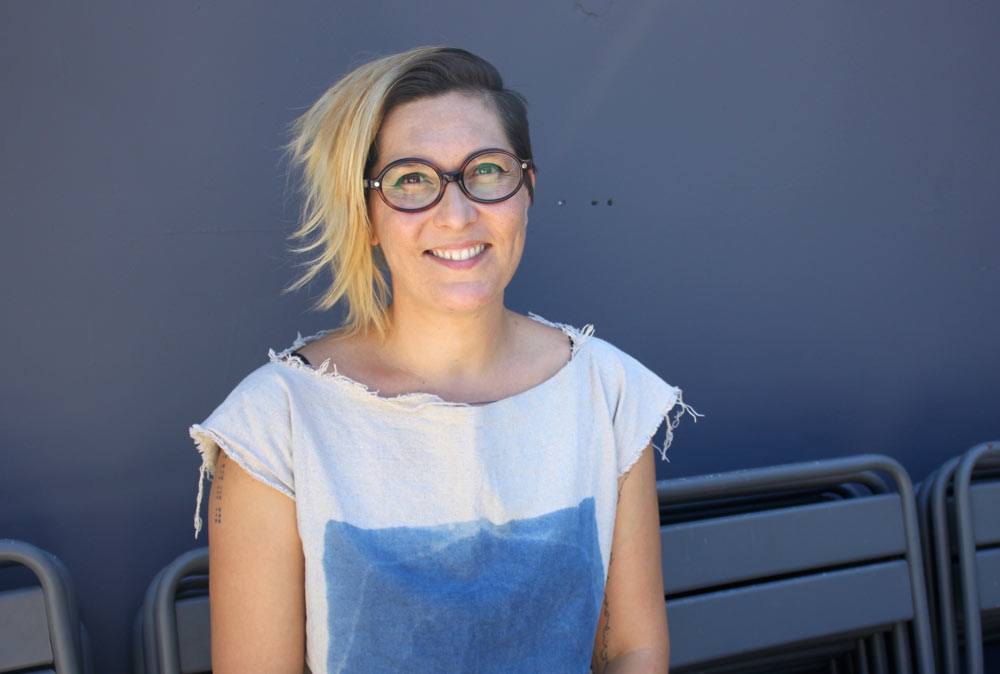
Growing up crossing the border every day to go to school in the United States was a critical part of Tanya's childhood, and informs a lot of her current art and design work. The isolation and frustrations—from violence to secrecy—that were a part of this daily process, gave Tanya a unique identity that wasn't quite 100% Mexican or American... her cultural identity remained in a confusing place that resembled purgatory. Her artwork became an outlet that set her free: listen to the episode above to hear more about how she channeled her emotions and experiences and carved out a space for herself and her family.

A young Tanya riding a horse.
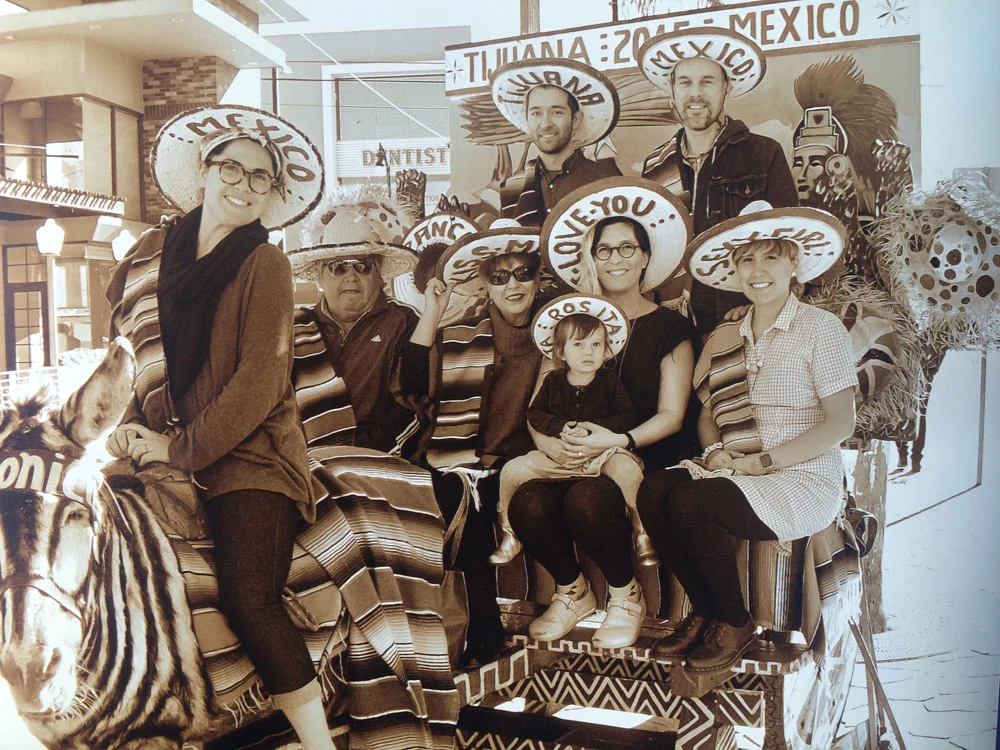
The Aguiñiga family
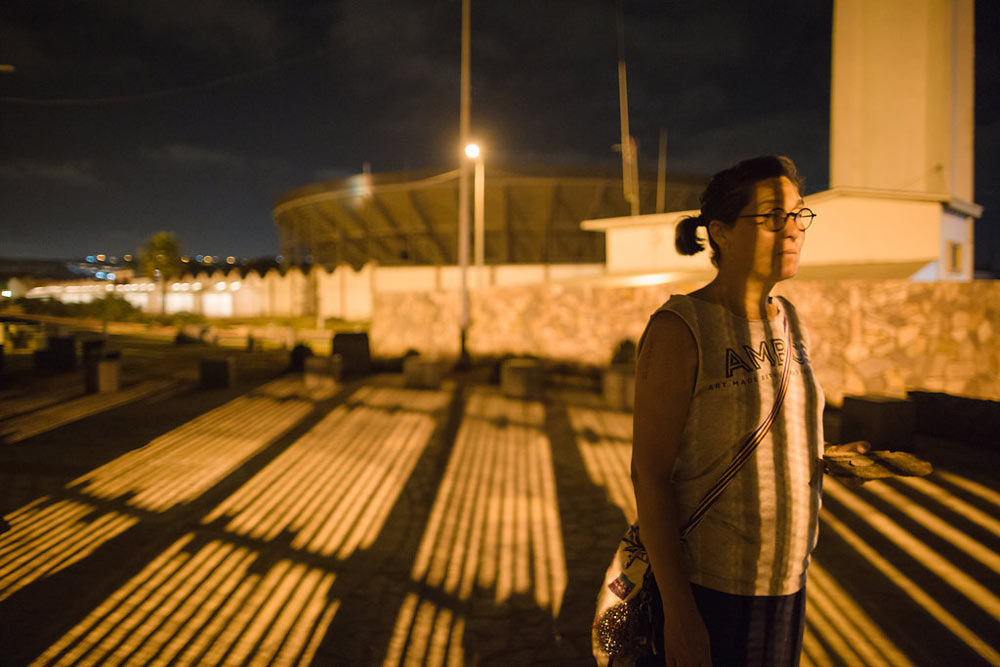
Tanya stands at the border wall. Photo by Gina Clyne Photography.
Tanya's most recent project, AMBOS, is a border activation with the goal to unite the community of people who cross the US/Mexico border every day through art. The project's first major activation just ended and she talks about the unexpected effect that it had on her and her family.

Tanya's rope jewelry, wall hangings and fiber housewares
Tanya is most well known for her use of textiles in both home decor and jewelry. From textile-wrapped chairs to knit bowls to fringed wall-hangings and rope bracelets, Tanya is a pioneer of the contemporary fiber art movement. In the episode she talks about how she studied with Mexican craftspeople to identify her life's calling.

Support (left) and Tierra (right), 2014, Volume Gallery

SHEvening, 2015, Merryspace in Los Angeles
Tanya's exploration of textiles in home decor and jewelry expanded into artwork and gallery installations, such as the ones pictured above. Not only does she create functional objects, but she also makes artistic sculptures that convey personal and universal statements about gender, identity and craft.
As mentioned above, her AMBOS border art project was designed to unite the commuters crossing the US/Mexico border. The project involved many projects including pirate radio stations, photography, documentaries, and her personal project—creating quipu using knots made by the community. Listen and find out more about the road to making this fascinating project come alive.
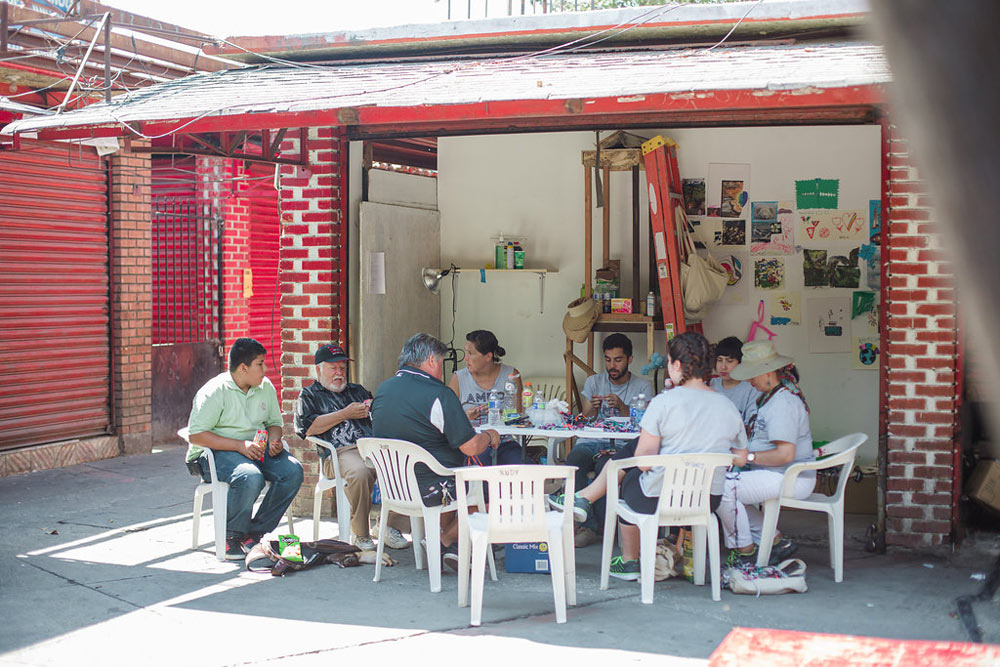
Tanya and her AMBOS team members tying quipu knots at the border market. Photo by Gina Clyne Photography.
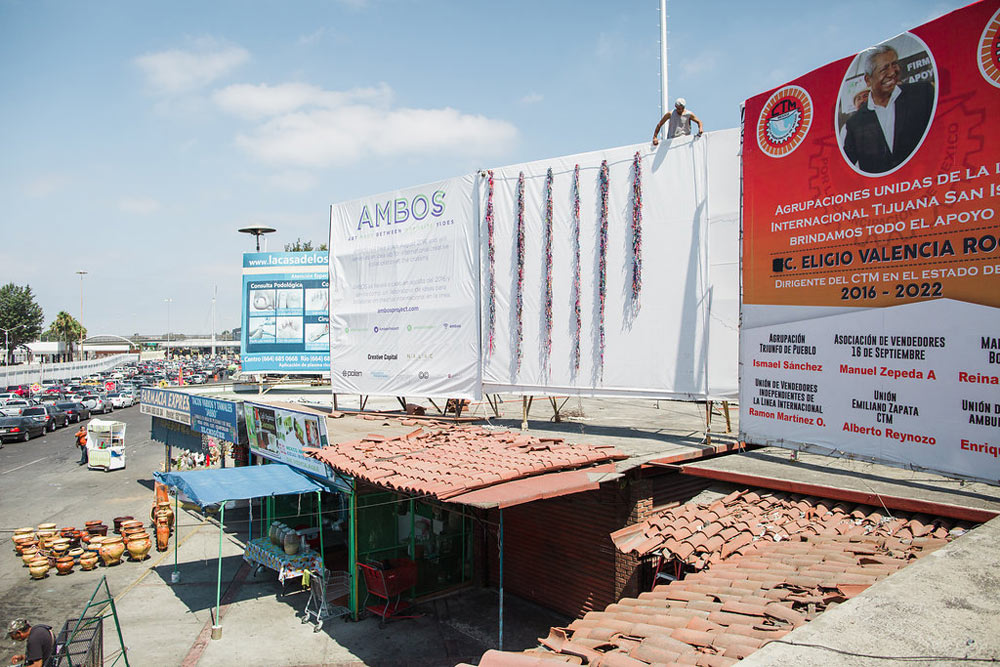
The AMBOS banner with quipu knots. Photo by Gina Clyne Photography.

Photo by Gina Clyne Photography.
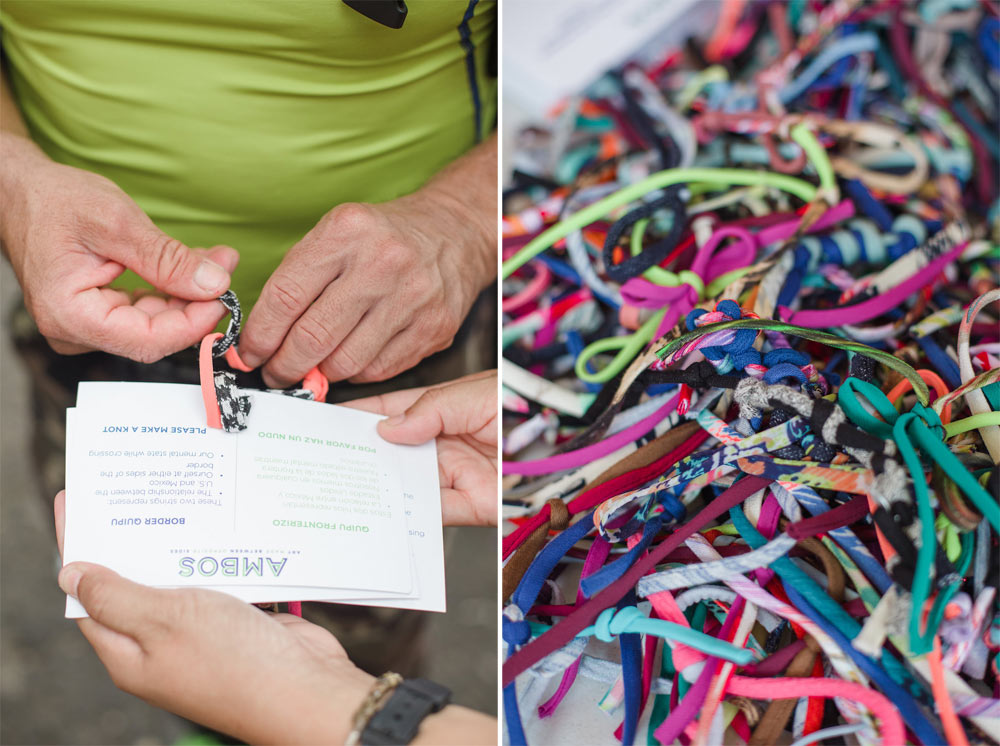
AMBOS interacted with those who were crossing the border to tie a colorful knot that culminated in a series of colorful quipu community art project. Photos by Gina Clyne Photography.
In addition to her work, Tanya talked to us about life in Mexico (i.e., how Americans perceived it and its reality), her family's interesting backstory that included neighborhood marriages and hopping border fences, as well as her early years hustling for candy and the family's pet eagle (say what!?).
For more of Tanya's work, visit tanyaaguiniga.com and follow her on Instagram.
To learn more about the AMBOS border art project, visit ambosproject.org.
You can also view Tanya's artwork or hear her speak at one of the following upcoming talks and exhibitions:
"Textiles: The Sense of Touch" (group show) August 27 - October 8, 2016, Lyndon House Arts Foundation, Athens, GA
Artist talk/lecture: September 15, Lyndon House Arts Foundation, Athens, GA
"Conglomerate Objects" (group show) September 12 - October 18, 2016 The Chan Gallery of the Pomona College, Claremont, CA
Panel discussion: October 15, American Craft Council Conference: Present Tense, Omaha, NE
Panel discussion: October 17, Design Sponge: In the Company of Women book tour, Los Angeles, CA
Artist talk/lecture: November 17: "What it means to be an ally" Temple Contemporary at Tyler School of Art, Philadelphia, PA
If you want more Clever, sign up for the newsletter to get notified of new episodes as they're released. Follow us on Facebook, Twitter and Instagram. And most importantly, please spread the word to anyone who you think would dig it.
Subscribe on iTunes, Stitcher, Google Play, SoundCloud, or subscribe using our feed via your favorite podcast app. And please, if you like us, give us a rating!
Special thanks to Chris Modl of Yore Studio for editing this episode.
Music in this episode courtesy of El Ten Eleven—hear more on Bandcamp.
Shoutout to Jenny Rask for designing the Clever logo.
Keep Listening