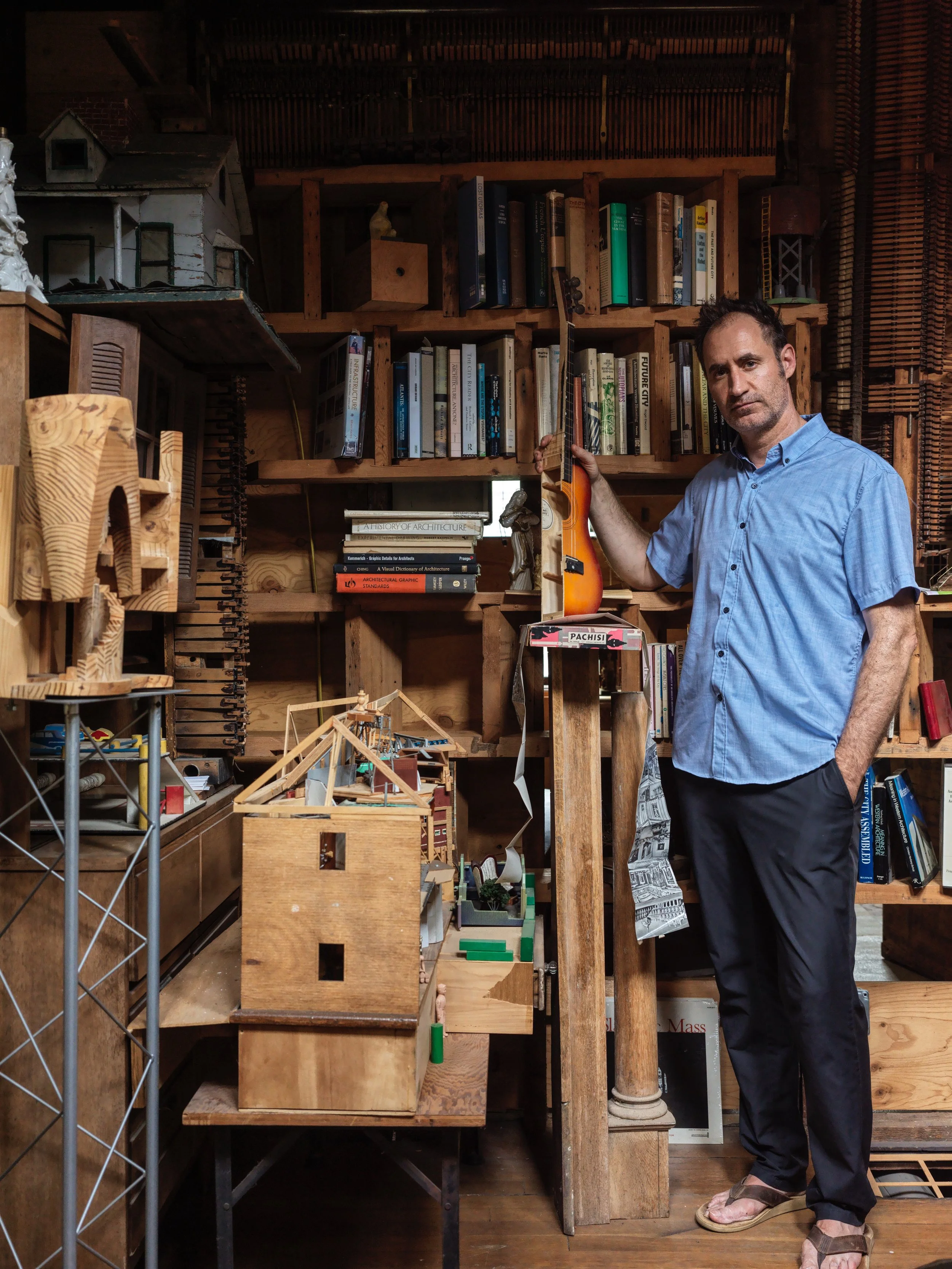
Ep. 41: Ini Archibong
Product designer Ini Archibong grew up taking things apart with little success putting them back together, and cutting class to throw pottery. After a false-start in business school, he taught himself CAD, philosophy, and mathematics until he serendipitously found himself apprenticing an architect. That led to a degree from Art Center and discovering a love of designing furniture. Now he lives and works in Switzerland where he recently obtained a Master’s in Luxury (listen to find out what that means!).
Keep tabs on Ini's designs at designbyini.com and follow him on Facebook and Instagram. Also, we recommend you listen to some of the beats he made while immersed in the LA beat scene: here's one that he recommends: https://soundcloud.com/eye-n-i/sets/tracks-oldies.
Ini Archibong: I would take apart the computers and try to make robots, and you know, every so often I would try to put something back together after I got in trouble for breaking it. (Laughter) I was very, very unsuccessful at that. I think the first thing that I actually successfully got to work, I was probably about nine or ten years old and I built a gas-powered remote-control car from scratch, which was a big accomplishment for me. It was a cool thing in the neighborhood because older guys in my neighborhood, a lot of them were into street racing, like illegal street racing, Fast and Furious style, before the movie, and for kicks they would make the model version, the gas-powered model version of the cars that they would race, and I loved hanging out with them and I was determined to build my own car to race with them.
Jaime Derringer: Hi everyone, I'm Jamie.
Amy Devers: I'm Amy and this is Clever, and today we've got Ini Archibald. Ini is an emerging product designer currently working out of Basel Switzerland. You may remember his name from a previous episode of Clever because we talked about him with Terry Crews in episode 7. They collaborated on a furniture collection together. Ini was born and raised in Pasadena, California and studied architecture and industrial design at Art Centre College of Design.
Jaime: After Art Centre, Ini moved to Switzerland where he got his master's in luxury from École Cantonale d'art de Lausanne. He's exhibited globally at galleries, museums, and design shows and has also been featured in Metropolis, Surface, Architectural Digest, and other print and digital publications. And he's done work for brands such as Hermes, Bernhardt, Herman Miller, and various European luxury brands. So let's talk to Ini.
Ini: My name is Ini Archibong. I live in Reinach, Basel-Landschaft, which is near the city of Basel, and I'm a designer, industrial designer, spatial designer, and sometimes artist. I do what I do for the culture and to advance things.
Jaime: I would like to know first about your upbringing, because I understand your parents came to the U.S. from Nigeria. Is that right?
Ini: Yeah. Yeah.
Jaime: What was it like growing up there? How old were you when you came to the U.S.?
Ini: Well, I was actually born in the U.S. My parents came for college and stayed. Even though I have Nigerian heritage, I grew up in America as an American.
Jaime: Where did they move to when they over? Where did you grow up?
Ini: I grew up in Pasadena, but my parents, my dad went to Columbia and my mom went to Rutgers. They were on the East Coast until they moved to California and had me.
Amy: Can you tell us about your childhood and what it was like growing up in Pasadena with Nigerian heritage and being an American and all that sort of cocktail of stuff going on?
Ini: My mom always used to say, out there, you're in America, but when you're in the house, you're in Nigeria. (Laughs) I was definitely raised as a Nigerian child. We had a very tight knit Nigerian community in L.A. also growing up. I mean, a lot of my closest friends to this day, you know, we grew up together, you know, seeing each other every weekend and celebrating birthdays, and weddings, and holidays all together. We had a very strong cultural upbringing, even though we were living in the States, and they made it a point to make sure that we knew about our heritage.
Amy: That's nice. And I imagine you probably had friends your age, too, who were also Nigerian American and dealing with all that comes up with that. You had people to bounce stuff off of..
Ini: Definitely.
Amy: Or a shared experience, I guess is probably…
Ini: Yeah, definitely, and because, you know, we had, actually, my older brother is two years older than me. Within our age group, you know, we had a lot of other Nigerian kids our age that we grew up with. It's really cool now because, you know, we're all adults and doing our different things throughout the world, and keeping up with each other on social media, and seeing each other when we're back home visiting and, you know, special occasions, we always see each other and our parents are still in touch and they still hang out with each other. It's a strong community.
Jaime: Were you like a creative kid? Did your creativity start at an early age? And if so, how did it manifest?
Ini: I was always a creative kid. I didn't realize it until I was much older. As a young kid, I did a lot of things that were probably indicators of what I would do later in life. I always liked to draw; I had a pretty vivid imagination. [0.05.00] One of the things that I used to do back then, that used to drive my parents’ crazy, is I would try to take things apart and combine them with other things to turn them into magical creations. I would take apart a calculator and remote-control car, toy and think that I was creating some sort of hybrid robot of some sort.
Jaime: Like transformers.
Amy: A natural synthesizer.
Ini: Exactly, exactly. I took everything apart. (Laughter)
Amy: Yeah, that would cause some consternation amongst the authority figures.
Jaime: Did anything you took apart and tried to combine actually work?
Ini: No. (Laughter)
Amy: But you learned a lot about how things were put together and about what made them work, and that's the best way to learn is to take things apart.
Ini: Definitely, definitely. I mean, I'm trying to think what one of the crazy… I grew up in like a very computer focused family. My dad's an engineer, my mom's a computer scientist. We always had old computers around the house. Every time there was a new advancement in computers, we would get a new computer. Then the previous one would be sitting there. I would take apart the computers and try to make robots. And, you know, every so often, I would try to put something back together. (Laughter) After I got in trouble for breaking it. I was very, very unsuccessful at that. I think the first thing that I actually successfully got to work, I was probably about nine or 10 years old and I built a gas-powered remote-control car from scratch, which was a big accomplishment for me. t was the cool thing in the neighborhood, because the older guys in my neighborhood, a lot of them were into street racing, like illegal street racing, Fast and Furious style before the movie. For kicks, they would they would make the model version, the gas-powered model version of the cars that they would race. I loved hanging out with them and I was determined to build my own car to race with them.
Amy: Oh, man, that's so cool. I love the generational interplay there, too, and it's also sort of quasi-illegal, so there's like all kinds of boundaries you're trespassing on, and I love it.
Ini: Yeah, definitely. I learned a lot of illegal things from those guys. (Laughter)
Amy: And were your parents supportive of this at the same time, just trying to mitigate the damage?
Ini: I don't know if supportive is the right word. They were supportive of stuff like building the car, for example, the car, stuff that was, you know, focused and not damaging of their property, they were very into. (Laughter)
Amy: Okay, that makes sense.
Ini: Of course, my dad's an engineer. I think there's like a bit of pride that came from watching me do something mechanical like that. They were very supportive of my brothers and I in a lot of ways, even though the art stuff, the creative stuff is definitely not their bag. My dad, he's an engineer. It's funny. He makes the same joke every time I tell him that I've designed a new table. He's like, you still haven't figured out how to make it flat. (Laughter)
Amy: Yeah, that's such an engineering joke.
Ini: But they're supportive, nonetheless. When I was young with, you know, the drawing and stuff like that, they weren't really, it wasn't that they weren't supportive, they just didn't get it. And then when I started drawing graffiti, it was a little bit different.
Amy: The graffiti was that in the teenage years, because, I mean, that's usually when we're struggling to really shape our identities and sometimes pushing back against what our parents understand about us.
Ini: Yes, it was very short lived, first of all. Well, actually started when I was 11, because I remember distinctly, when I first wanted to try my hand, there was somebody at my old school that was really good, and just started, you know, writing my name and drawing during class, because that was the other thing is I did most of my drawing when I was supposed to be paying attention in class. By the time I was 12, you know, I started at a new school and I was taking a bus to the other side of Pasadena. That was when the bus tagging type of stuff started happening. I wasn't like a Picasso; I was more like LA street graffiti. And most of my really good stuff stayed in the sketchbook. I did that all the way through high school, I was always writing in the sketchbook and stuff like that, because the friends I had that were out there bombing, you know, would be getting in trouble. And my parents were not with that at all.
Amy: In terms of the teenage years, and your sort of burgeoning creativity, did you have to find some edges and [0.10.00] some boundaries to push against? Or do you have any times that you felt kind of lost and not sure what to do?
Ini: Yeah, like in the teenage years, again, the art, it really started around 12. The art wasn't a rebellion thing for me. Not until a little bit later, it really started with just being exposed to art. Because like I said, before I started at the new school, I started a school called Polytechnic, which was in Pasadena, it's one of like the elite prep schools, and they had a lot of resources. There was a very strong arts department and they, you know, were into having very well-rounded students. Prior to that, the only art I ever saw was the graffiti on the freeway and that was kind of my world. And also, like, in my neighborhood, there were also a lot of low rider cars that guys would soup up. And to me, that was like, you know, luxury art, all of that, you know, beauty. And then when I started at the new school, they had a computer lab, and I started doing pottery. That was really what got me into art, was throwing pottery. And I was doing digital art when I was like 12 and I was obsessed with, back then it was like the earliest Photoshop, like the first 3D programs, I started on like KPT Bryce and Ray Dream Designer and a lot of programs that don't exist anymore. So that was really the start for me, and it wasn't rebellious, because it was very encouraged at the school. It didn't turn into a rebellion until I was in high school, and I got pretty good grades, but I was a horrible student. I used to get in a lot of trouble because, you know, I was hyperactive. I didn't do well controlling my impulses, we'll say.
Amy: Can you give us an example.
Ini: Examples, like too many to name. Technically, they tried to kick me out of every school that I've been to except for where I got my master's.
Amy: Is this just you doing whatever your attention pulls you to, not controlling your impulses? Or were you acting out?
Ini: It wasn't really acting out. Yeah, I was just not controlling my impulses. One thing is that I learn in a very particular way and I was able to learn very quickly. I basically got 100% on almost any test I took back then. And I would digest the information in my own way, so I didn't have to pay attention like the other students and I couldn't concentrate to do homework. I would just be in class kind of drawing and getting in trouble because the teacher doesn't think I'm paying attention and then repeating everything that they had said since the beginning of the class verbatim like a tape recorder.
Amy: Oh, yeah. Too smart for this system. (Laughs)
Ini: Yeah, almost, except I didn't figure out how to work the system, so I spent a lot of time in the principal's office. I think the first time I went to the principal's office, I was in kindergarten, and I went for cursing.
Amy: At what point did you discover music? Because I understand you were heavily involved in the LA beat scene.
Ini: Yeah, I was actually, I started music when I was nine or 10. And my parents again, they didn't understand. I just out of the blue requested a piano, and they got like an old used out of tune piano. I tinkered around on it. When I was old enough to be in the elementary orchestra, at my old school, I asked for a flute, and I started playing the flute, and I advanced pretty quickly in that to the point where they moved me with the older orchestra. I think eventually I was first flute before I left that school. And when I was 12, I started the new school and the kid’s made fun of me because I played the flute, so I switched to the saxophone to be a bit more masculine, I guess. (Laughter) And then I played the saxophone for a few years. And then when I got to high school, I realized that popularity points don't go to the band members as much as they go to the athletes, so I concentrated more on sports and put the instruments down. And then I didn't start making music again until I dropped out/got told to leave USC. And then I started making music.
Amy: Your poor parents, they must have been like, pulling their hair out with like being so proud and so concerned.
Ini: Yeah, I think so. I think my mom still goes through that. (Laughter) I've always had the musical stuff in me. I've always had like sort of this tumultuous existence, [0.15.00] I guess, because I don't know, there was definitely a feeling of not fitting with the world around me for the majority of my life, probably until my 20s, until I made a decision to be an artist and damn what anybody else would think. Up until that point, it was pretty rough in a lot of ways.
Amy: I can relate to that. There's hopes and dreams your parents have for you, and then there's all this stuff that society is trying to corral you into. Until you give yourself the permission to be an artist, and then embark on that really difficult journey in itself, you're in this pattern of justifying your own creativity, or trying to find a reason to justify it, and it's not supported necessarily, so you're not sure how much gas to give it.
Ini: Yeah. And you know, the funny thing is, in retrospect, when I left USC, and I was forced to really think about what I was going to do, that was when it became clear to me. I guess I never compromised doing my creative thing. I just kept it to myself. Like in high school, I can't believe I'm saying this on something that's going to be made public. I used to call into school pretending to be my dad and tell them that I was going to be late and miss like the first half of the day, pretty often. And I would get to school in the morning and go straight to the ceramic studio and I would throw pottery until lunchtime. And then I would go and hang out with my friends at lunch and then go to the second half of classes so that I could be eligible to go to my sports practices after school. (Laughter)
Jaime: I love that you cut class to throw pottery. (Laughter)
Ini: The funny thing is the ceramics teacher; he was like one of two of my first creative mentors. He taught me a lot about not only art and life. Shout out to Stuart Freed. He was a pretty well-known ceramicist, and I think he still is. He taught me a lot of life lessons through the craft, you know, certain things like relishing the journey over the destination.
Amy: That's a good one.
Ini: I remember one time I used to run the kiln, so I would throw these like really big pots. I was getting to a point where I was getting pretty good. If you've ever done pottery, if you're not patient, you know, you can get air bubbles within your big pieces of clay that you're throwing, and then they'll explode in the kiln. I was having pots that kept exploding and I was frustrated. He came in and he saw I was frustrated and I told him about it. And then he just like sat down and he threw just like, probably one of the most amazing pots I could never imagine to have thrown that moment. And then he just like smashed it, rolled it up into a bottle of clay and then threw another one. He just kept doing it. He's like, who cares? You know, it's about doing it and not about what you're going to get from it. He taught me a lot of lessons like that. In the midst of, you know, breaking the bongs that I would make and try to fire, (laughter) was a super, super cool guy. He was the only person, I think, that knew that I was cutting class to be in there. He never snitched.
Amy: That's nice to have an ally like that, kind of a partner in crime, a sensei of sorts, who knows you're breaking the rules a little bit, but it's for your own good, so he lets it happen.
Ini: Yeah, yeah. Of course, he was a proper teacher. He turned somewhat of a blind eye, but vocally, he always told me to do what I was supposed to do.
Amy: Yes. Yes.
Jaime: That's awesome. I want to go back to what you said, so you said you left USC, what happened after that? I know you went to a couple of different places after that. How did you get to the master's degree?
Ini: From USC to the master's degree? Wow, that's a journey, so fasten your seatbelt. USC, I was there for two years, I had a presidential scholarship. I had almost all of my tuition plus all of my books and stuff like that. To have one of those presidential, I think it was like the business scholar’s thing. It was pretty strict what classes you had to take. I went into orientation and they basically laid out, you know, four years of my life with all this like accounting, econ, all this kind of stuff.
Amy: That's my version of hell. [0:20.00]
Ini: Yeah, it was mine too. And I barely made it through the general intro stuff before I stopped taking the classes that were required of me and started walking in on and sitting in on classes that I either wasn't registered for or wasn't supposed to be taking, but managed to register for. I was taking like a bunch of philosophy and art classes and not doing my required classes and also getting in a bit of trouble here and there with the campus security, but nothing major. At the end of the day, it was a matter of having the choice of going back and taking a semester off and getting things together and then coming back and restarting all of that. Once I stopped, I just kind of examined my life. I wasn't happy with where I was. I didn't feel like I was with my tribe, so to speak. I had my roommate who at the time was like my best friend. We would talk about these things and I was also getting very into esoteric sort of spiritual stuff, and philosophy, and really developing a perspective. Because of all these things, I started to really examine who I was and why what I was doing wasn't matching and why I felt like I'm sort of out of place kind of my whole life. I then really came to the conclusion that I needed to focus inward, especially when it came to judging myself, that it needed to come from me and not from outside and not from what anyone else thinks, and feeling like a failure based on what other people's standards were didn't make sense. That I wouldn't be failing unless I was failing by my standards on what was important to me.
Amy: That's a powerful place to get to. I wish that I had gotten to it as early as you did.
Ini: It's pretty life shattering when you're like 20 years old.
Amy: Yeah.
Ini: But at the same time, very liberating, because the conclusion I came to is to look back and look at what I was doing, and it made me realize what had been constant and consistent. The one thing that had followed me through my life was my creativity. Even during this time at USC, I spent my free time building 3D models of space architecture and rendering them. This is so nerdy. Rendering them and printing them out on 11 by 17s and stopping them in a folder in my apartment. I stopped going to USC. (Laughter) I enrolled in art classes and I didn't know what I was going to do, but all I knew is that I was going to do what I enjoyed. I just went and I registered for ceramics classes and started making music again. I got Fruity Loops on my computer and Reason and started teaching myself how to make beats, and doing art, and reading spiritual books, and kind of going down a spiritual path that led me to the conclusion that for me to feel satisfied with my life, I had to be on a path where I was trying to change the world for the better through the skills that I've been given. I decided to actually at that point, try to become an architect.
Amy: That's a powerful realization. You sort of had to crack your sense of self into many pieces and rebuild it on your own terms. Then you have to forge a path and get everybody else who's trying to support you on board with that. I mean, that's not always that easy. Did you start by going to architecture school or how did you start pursuing architecture?
Ini: No, actually, at that point, like you said, getting other people on board is not so easy. My approach to it was to pretend like I was still in school. I basically stayed with my old roommate who let me slide on the rent until I was able to take care of it. I just started getting books on architecture. I just started looking at architects that I liked and started drawing some of my ideas and making beats. I was at the time very, very heavily focused on the effect of the spiritual geometry that has been passed down through the ages. I was reading a lot of Manly P. Hall, and learning about the Pythagoreans, and trying to understand what the makeup of geometry was, and how it affected people, and why we use the geometry that we use, and looking into like Euclidean geometry, and things like that, and just sketching ideas, and thinking about that, coming up with a lot of unrealistic ideas of spaces [0.25.00] and how they could affect people's spirits. And reading a lot about cathedrals, getting into the gothic architecture. Then there came a point where I didn't really have a choice but to move back home. While I was at home, there also came a point where I had to get a job and my parents were really like, what are you going to do? Funny enough, I was in South Pasadena taking my mom to do something, run an errand. I dropped my mom off and I'm walking on Mission Street and thinking to myself, with my sketchbook, because I always had my sketchbook, and I walked past this space, you know, it wasn't like an office space but it's more like a storefront, and it was all glass, and there was a man inside hunched over a table, and on the window, it said, George Architecture. I walked past it and then I doubled back and I turned around and walked in and he was like, “Can I help you?” And I just said, “I think I want to be an architect but I don't know what that means and what it takes and what goes into it. Can I ask you some questions?” Like any self-respecting, middle-aged architect, he said, “Can't you see I'm fucking busy?” (Laughter) He said, “If you want to talk to me, I go to Buster's every morning around 7am before I start work. If you want to talk to me then meet me there.”
The next morning, I went and I met him and he said that he liked that I carried a sketchbook even though the drawings were crap. He invited me to the office, and at the point where I was thinking, hey, you think I could work for you or something? He was like, you're of no use to me, you'll only get in the way but I've got an extra computer. If you come in here promptly and don't get in the way, you can use the books on the bookshelf and try to figure out this CAD program, and if at some point you make yourself useful then you can have a job. It's pretty crazy. So yeah, it took a couple of weeks because like I said, I started using pretty complex 3D programs from the age of 12. I had an approach to software. I never tried to learn how to execute something. I tried to figure out the way that the software's brain operates because then you can find anything, but if you keep searching around like, what do I push to draw a line? You're never going to figure out how to draw a line and then you're just going to figure out how to draw a line. I tried to get into the brain of CAD, and once I started to figure out how it moves and how it thinks, I started drawing some of the things that I found in the Frank Ching books. Frank Ching was the authority on architectural drawing from way, way back. Like old architects learn how to draw from Frank Ching. He had all these books. I would draw plan sections and elevations of typical balloon frame housing and stuff like that. And then I was getting better. He started giving me assignments like to draw the cabinets in the office and then he'd give me like floor plans of an old project and then have me extrapolate elevations and sections off of them. After a couple of weeks, you know, I proved useful. I ended up working for him for about two and a half years, almost three years. I was making music at night and being an architect's apprentice during the day, only educated on the job and in the field. He used to take me after I drew something, he would take me to the construction site, show me the reality of what I had drawn. He taught me how to think, really, really, really think beyond the lines and how to see things in the world and then abstract them into the lines and take them apart in my head. Yeah, he gave me the foundations of everything that I do now. His name is Tony George, South Pas. You should go find him.
Amy: Yeah, I want to I want to buy him a cup of coffee to say thanks. (Laughter)
Jaime: Yeah, really.
Ini: I actually, I see him whenever I go home.
Amy: Oh, that's so nice.
Ini: He's super, super proud. I showed him what I was doing and he put it on his website. (Laughter)
Amy: He made a major investment in you.
Ini: He did. He did. I mean, it's not like he paid me handsomely, but honestly, if he hadn't taken that chance on me, I don't know what my path would have looked like because it was a moment where I was completely lost. He not only gave me an income and the ability to move into my own apartment, but also the education and the fact that somebody, you know, believed in me and was willing to bet on me and trusted me. [0.30.00] I think that was a big thing because we did get to a point where he would show up with sketches of his ideas and he drew amazingly, like a madman, like the way that he would draw, I would be able to take his sketches from napkins or a sketchbook and then start making, you know, a full building out of it. One of the things that he really taught me was a way of thinking, of subtracting to the essential in your thought process. He could do a sketch of like the overall, this is what the house should look like and these are the important… there's also like the, what is essential about making it have the feeling that it has in his sketch, you know, and those he would break out into his sketch details, which would be very well thought out and articulate and clear. Like with a Spanish home, you look at the sketch of what the facade looks like and you know, you don't necessarily know what you're liking about it. But then when he would break out the detail, he would show me like, in order to achieve this, we're going to need to make sure that the walls are really thick and the windows are deeply inset and like all these different things really, he showed me how to articulate those things pretty clearly in his drawings and got me to a point where I could achieve quite a bit just from his sketches.
Jaime: That's an incredible story. I'm like, my jaws on the floor, but just because you were able to just walk in one day and meet this person who basically gave you an opportunity, but also gave you the confidence that you could do something with this ability that had been like haunting you throughout your childhood. So that's fascinating. What was the next, like, what did you do after you worked for him for three years? Did you decide to go back to school?
Ini: Yeah, that's what I did. While I was working with him, and he, as he had his own way of being encouraging, I will just say that I appreciated it a lot more later, but he was pretty hard. He didn't allow me to take it easy on myself. We've had conversations about that afterward. He was pretty clear. He was like, what are you going to do with your life? He wasn't going to let me settle in, you know, and not take it further. While I was working for him and making music at night, I started taking classes at ArtCenter at night, which was a program that's open to the public, and I was able to get a scholarship to some of the architecturally focused classes based on the portfolio that I had been able to build while I was working for him. I was also, on my own time, taking the skills that he had given me and designing my own architecture and doing everything that I did for him. Making real plans and section elevations for constructible buildings. There came a point in 2007, and at this point I'm like 24, I went and I enrolled at art center. That was a big decision and a difficult decision because of the music, because I was getting pretty good and the guys that mentored me in the music worlds were, you know, it was very clear that what we were doing in LA was going to be something big.
Amy: I know a little bit about... I never played an instrument, but I was present during a burgeoning creative scene, a music scene where there was just this electricity, and this excitement, and this build, and you just knew it was going to be something. I'm sure it was really hard to be a part of that and be a major player in that and then have to extract yourself from it.
Ini: Yeah. Yeah, it was difficult. And you know, I didn't share my music. I made thousands of songs and the only people that heard them were my mentors really, and a few pretty key people in the beat scene because I wasn't really putting myself out there. Then the decision was either I'm going to take everything that I've done and start putting it out there, like my peers, or I'm going to take this design thing full force. It really boiled down to the fact that I felt like I was going to have a much bigger impact creating the background for people's experiences, as opposed to creating the background music for people's experiences. I got a scholarship to attend ArtCenter and I didn't, like, stop the music. I actually used to keep my MPC in my locker, pulling all-nighters. I would take about an hour and make music, and that's kind of where I started the practice of designing and making music at the same time. That led to me just plugging in my MPC in the computer lab, you know, while I was working on my projects and doing everything all at once. [0.35.00] So then I was at ArtCenter for the next five years. I think you're supposed to graduate in three. (Laughter)
Jaime: Why were you there so long? Were you just working and taking classes, or was it because you kept switching your focus, or you just wanted to take as much stuff as possible?
Ini: I'm not really made for like organizations, and systems, and things like that. I have trouble with following directions, (laughter) or following rules rather. An example of that, I probably could have graduated earlier if I didn't take the same furniture class five times, there's one furniture class that's an elective, and I took it five times because I loved making furniture after I made the first piece.
Amy: I have the same story. I could have graduated in three years from San Diego State, but as soon as I found furniture design, I took a class every single semester and it took me a few more years to graduate. But I was like, I can't leave yet. I don't know enough about furniture. I have to keep making furniture.
Ini: Exactly. That was when I found it, you know, I came into ArtCenter with like a pretty clear understanding of who I was. It was hard for me to spend the time doing the exercises that were designed to be searching, so to speak, for students. I knew where my skills lay and I knew where I was going to be best able to express my visions. And that was in the 3D realm and in the shop. I kind of took the approach of going above and beyond in the things where I knew that I had the opportunity while I was on scholarship at ArtCenter with those facilities to advance my knowledge to the point of being like astronomically good, as opposed to being well-rounded. That's hard for an institution to take in. And obviously, there's questions, when I go into my fourth term review, which they have, ArtCenter is very hardcore, it's very competitive. So even if you get into ArtCenter, which is very difficult, there's a point where ArtCenter can tell you, look, you've been here for enough time for us to know this is not the place for you. (Laughs) I remember that fourth term review was like, we see a lot of promise. You've got to pull this together because you're on the edge, you know?
Amy: Yeah.
Ini: And you guys know, David Makarsky, right?
Amy: Yeah.
Ini: David was my department chair. And David believed that there was more to come from me. And then I took my first furniture class the next semester. That was the Bernhardt studio, and that was the first piece of furniture that I ever designed. I worked on that in a team with John Phillips and Stephanie Stocker, two of my good friends and former schoolmates. We won that, and our piece went into production for Bernhardt and it introduced me to the world of design. And that's when I finally, this is like 2010, at this point, I'm 27. Finally, I walked into ICFF. I was like, this is my tribe. (Laughter)
Amy: You found us, we found you.
Ini: It was an amazing feeling, you know, because I know up until that point, I thought, oh, I'm working on becoming an architect. I wanted to take the furniture class because it seemed interesting and seemed fun. And then it became an obsession.
Amy: Furniture can become an obsession.
Jaime: I need to know what a master's in luxury is, because that's kind of where you ended up. That's also how you ended up in Switzerland, right?
Amy: Can I just tell you, like my cartoon version of a master's in luxury is like, this is how you ride in a private jet. This is how you make caviar. This is how you bust the cork on the Moet.
Ini: That became a lot of it for me. Not the private jet part, but honestly, moving to Europe and dealing with these brands that are the height of luxury, I did have to reacclimate myself with etiquette. The brands lay out, three course meal for us. It’s like, you shouldn't use the wrong fork. You should know what's proper, especially since for them, everybody knows these things. In America, it's a lot more relaxed. Luckily, I did cotillion when I was young.
Amy: What's the curriculum like in a master's of luxury?
Ini: It's a unique program. ÉCAL has cornered the market on luxury education, I guess, in that sense. It's a crash course in how to design and work with the craftspeople and the people that are involved in the luxury industry. [0.40.00] The Master's of Luxury is kind of a misnomer. I think they're calling it now the Master's in Design for Luxury and Craftsmanship.
Amy: Okay, that helps explain it.
Ini: It's a misnomer calling it a Master's of Luxury, because it's really more than anything about craftsmanship, which is a core element of the luxury industry, as opposed to what I learned at ArtCenter, which is a lot more commercial. ArtCenter was like an industrial education, I learned how to make things. And at ÉCAL, it was more about the elements that go into crafting the narratives that are part of the luxury world, as well as an understanding of how to design for an industry that still does things much in the same ways that they were done hundreds of years ago.
Amy: So, you got yourself a master's of luxury and probably got really well versed in the lost arts of, I don't know, glass blowing, and upholstery, and all these wonderful time-honored traditions. And then you become a professional designer. And now you're working with a lot of that craftsmanship in your work. Can you tell us some of the highlights of your professional career since you launched your own studio?
Ini: Obviously, SaloneSatellite in 2016. That's the biggest highlight. I started working on that project with Terry as soon as I graduated.
Amy: And just for our listeners, I want to remind you guys’ Terry Crews talked about this collection on the Terry Crews episode. So that's where you've heard this name before.
Ini: SaloneSatellite was really my debut in this realm, because I started my business while I was at ArtCenter, and I had done contract work with U.S. brands, so I had some stuff out in the world before this, but the designer that you see today, after having gone through the education at ÉCAL, that was expressed in that collection, the Secret Garden collection in 2016 in Milan. That's probably the biggest highlight. It was an opportunity for me to take what I'd learned since living in Europe and apply it, and apply it in a way that was not typical of most of my peers. There's something about not being from here that allowed me to break certain rules, or not know that I was breaking rules as I was breaking them, like culturally.
Amy: There's a freshness when you are interpreting things as a cultural outsider, you have a perspective that's different than other people, so you don't get caught in the same ruts as everybody else.
Ini: Yeah, exactly. And also, it was thanks to Terry, it was the first time that I've ever put the skills that I've been honing for so long to use just purely for a vision in my head. And it was the first time that I'd done anything that was leaning into the world of combining art and design.
Amy: It's a beautiful collection, and it must have been a wonderful opportunity to explore it to that depth and have another person who's helping to put energy into you to help you do what you do best.
Ini: Yeah, I've been lucky in that regard. I mean, I've had quite a few very important people that took risks on me throughout the years and mentored me throughout the years.
Amy: You must attract that into your life through your personality somehow.
Ini: Somehow, I don't know how it happens. (Laughs)
Amy: I want to talk to you about your creative process because I'm wondering, you seem to me like somebody, you've studied philosophy and mathematics, you have this engineering sort of technical part of your DNA, you've always been interested in how things work, and yet you're very aware that you don't work in the way that society or the institutions really want you to. Your self-awareness and your ability to attract mentors is fascinating to me. Can you talk to me about your internal dialogue that you have with yourself during the creative process? How do you know when you're onto something that's worth pulling at, a thread that's worth pulling at? Or how do you know when it's time to like scrap something and move in a new direction or take a break so that you can, I don't know, get a fresh perspective?
Ini: My process is one that's kind of akin to, when I'm designing something, it's like being on the football field. It's a matter of knowing that you've put in enough work and practice so you don't have to think when you're playing. And it's all muscle memory and reaction. That's the way that I design the concept. That's usually where something gets either, whether it's green lit or it gets scrapped in my head. The strength of the concept and what is communicating. If I believe in something and what I'm trying to communicate with it, then I go through the process of creating it. And once I get over that threshold, then I see it all the way through. Once I get over that threshold, then I see it all the way through. [0.45.00] What that means is that for anything that I design, usually there are three or four fully designed alternative products for each one thing that gets seen. And then there's a process of looking at them and seeing which ones express the qualities of what I'm trying to say. My process is extremely fluid. I can walk you through it. Once I have a concept and I determine what it's supposed to feel like, I walk over to the shelf and I start pulling out records one-by-one.
I find all of the records that have songs on them that have the same vibe of what I'm trying to get through in my products. And then I take the record, I put it on the record player and I let it play while I think, sketch some ideas, pace in circles until something crystallizes. Or I hear a sound, or something that epitomizes what I'm trying to make in my design, and then I pull the record back and I sample it and I loop it. And then I start the design process with that looping to continue to keep me inspired. I'll have that looping, I'll pull out books, I'll look at references, I'll sketch or I'll start designing. And then it's a fluid process. I have a table where I sketch and cut materials, and then I have a table where I have my synthesizers, my samplers, and my turntables, and my computer. It's like the cockpit of my spaceship, and I just do everything kind of all at once.
Jaime: Oh, that's really interesting. I would like to know a little bit more about some of the challenges that you encounter with running your studio.
Ini: I think the biggest challenge is the fact that my studio is me. (Laughter)
Jaime: You are your own biggest challenge.
Amy: I know that challenge! You're like the toughest boss and the laziest employee. (Laughter)
Ini: Exactly, exactly. It's been an eventful couple of years for me with a lot of projects that have launched and a lot of projects that are coming. Yeah, I'm doing it alone. That's probably the toughest thing is that I don't have any interns, employees, none of that stuff. I've got to organise my time. I've got to make the trips; I've got to be at the shows. I also have to design the stuff and make sure it's good, as good as I can make it.
Amy: Yes, I mean, that's also, that's a growing pain, right?
Ini: Exactly.
Amy: We like seeing you at all the shows. I lament the day and age when you send your employees instead of you.
Ini: That's never gonna happen. (Laughter) I don't know if you realize, but in order to have stuff at the shows, that means I don't have a social life until I go to the shows.
Amy: Oh, right. Yes, I know all about that. (Laughter) And then you have to have so much social life in those four days.
Ini: Yeah, exactly. Exactly.
Jaime: So you are an American who has Nigerian parents and you are living and working in Switzerland. You're a citizen of the world. Do you feel like you have particular roots, or do you feel rootless, or do you feel like you're being pulled in all kinds of different directions? And maybe talk a little bit about where those roots pull you toward or from?
Ini: You mean in terms of like, feeling at home or?
Jaime: Yeah, like home and like self-identity or cultural identity.
Ini: I lived in LA until I was 29. And most of that time I lived in Pasadena, and then I moved to Singapore, and then I moved to Europe. So physically, like physical home, it's weird to say, given that I just told you that I've lived there for 29 years, but I don't feel that I have physical roots. As far as home, I don't get homesick. I don't really get attached to where I'm currently living, and I guess I feel like the world is the world is my home. I can be anywhere. And that's just in terms of like, where my physical home is. Culturally and identity-wise, there's no question that my cultural identity is as a black man, Nigerian and American, like an African American, that's culturally where I come from. I guess for me, that's different than feeling like America is my home. It's also because I'm first generation, my parents left their home to get to America. I left America and I haven't really, I haven't settled yet anywhere long-term, [0.50.00] I don't feel like. I think it's easier for me to have that perspective because my parents, there's not like generations that have lived in America. The one thing that is to me very important and that defines and shapes who I am, is that especially having, like in reference to America, is the fact that I grew up in American culture of the 80s and 90s in Los Angeles. That has greatly shaped who I am. The way that I grew up and the experiences that I've had around the world, the conclusion that I've come to is that there's not that much difference between people.
Amy: Yeah. Shared humanity.
Ini: Exactly. It's not easy to get to the point where you feel unity with everyone, basically. And I don't know if it's the travel that has brought this about or the political climate that I grew up in. There's something about personally feeling like an outsider, being a black male growing up in America, growing up in L.A. during the time of like the riots and all of that, having the experiences that I've had, and also like going to school from age 12 to 17 in a school where I was only one of two black males there, and having those people be like my lifelong friends, you know, people that have a vastly different experience than me and being able to relate and connect, from so many different backgrounds and being able to relate and connect. And then coming here to Europe and having the same experience with the people from completely different backgrounds, being able to relate and connect. And those things make it difficult for me to really hold on to anything necessarily beyond recognizing how it shapes my worldview and makes me who I am. Outside of that, there's not really much identification to a place or anything like that.
Amy: It sounds to me like you're saying like the roots and the branches of your tree are sort of growing through your relationships and your experiences more than a physical locale, more than a place on a map. Let's talk about your future and I want to just zoom out from the artwork and the design for a second and talk about big life questions. If we were to fast forward many years from now when your grandkids are in junior high and they have to write a biography on their granddad for homework, what do you hope they might have to say about you?
Ini: I would hope that they could pinpoint one thing that I did that inspired them to dedicate themselves to helping everyone else because that's the overall goal.
Amy: Yeah, and you're very clear on your purpose and you are also very clear on your desire to transmit that purpose from generation to generation.
Ini: Yeah, I think that's my job here.
Amy: I think it's the point of humanity, actually. Not everybody gets there. (Laughter)
Ini: I might as well work on doing that. It's funny, my life, I went from feeling like everything I touched turned to shit, to the exact opposite, as soon as I dedicated myself to doing things for the sake of everyone else.
Amy: That's amazing. That's an internal shift in perspective that really opened up your life for you.
Ini: Completely. I mean, all of these mentors and all of the stuff that has happened, I can't explain. I feel very fortunate, we'll say, and that feeling of all of these fortunate things, these fortunate serendipitous events, you know, it might be true, it might not be true, but for me, they're connected to the fact that A, I feel like I can't be doing anything else. I feel like I was born to create things, but B, because the things that I create, I create them with, at least with the hope that they will be of benefit to others and inspire others, or allow others to escape from the mundaneness of everyday life.
Jaime: Speaking of creating things, is there something that you aspire to create or you'd like to do in the future?
Ini: A temple.
Amy: Wow! Yes. Yes.
Jaime: I love that there was no hesitation there. You knew exactly what you what you want to do.
Ini: Yeah, I'm working towards that. There came a point where I realized that if I wanted to be an architect, and build temples, and build these spaces to affect people's lives and affect people's spirits, [0.55.00] that if I wanted to be an architect and do that, I'd have to do five years of architecture school, and then I'd have to like toil as an architect until I was like 70 years old before anybody would let me do that. (Laughs) On the flip side, being a designer and focusing on things at the smaller scale, the scale that people touch, you end up piecemeal, slowly affecting people's experiences with the things that they touch, and it allows you to have the trust to do bigger and bigger things as you go. In that way, I hope that I'll be able to build a temple, that I will instill enough trust in people to allow me to build some sort of spiritual space before I reach 70 years old.
Amy: Well, I hope so too, and I'm already planning my pilgrimage, so you better get to it.
Jaime: Are you working on anything right now that you can talk about or give us a sneak peek of?
Ini: So much secrecy in my life regarding that. Yes. Are you familiar with Sé Collections?
Amy: Yes. Oh, that's such a perfect brand for you.
Ini: It is a perfect brand for me, and I have been chosen by Sé to design collection number four.
Jaime: That is so exciting.
Ini: If you know Sé Collections, you know that they've only worked with three designers so far and three noteworthy designers so far.
Jaime: Yeah, it's very high-end luxury and they're very exclusive.
Amy: Well, congratulations on that. I guess the best thing we can do is stay tuned to your website and social media. Do you want to tell us where our listeners can find you?
Ini: My website is designedbyini.com. Be wary of designsbyini.com. I don't know who that is or why they have that site.
Amy: Oh, man.
Ini: Yeah, I know. It's strange. You can find me on Facebook, facebook.com/designbyini and on Instagram at iniarchibong.
Amy: I wonder how many people are going to stop in Tony George's architecture firm and ask for apprenticeship after this. (Laughter)
Jaime: You better warn him!
Ini: That’ll be amazing, I'll write an email and let him know. Yeah, that was that was 10 years ago, which is crazy to think. I mean, I just graduated recently, so.
Amy: Well, congratulations on your rising star. We're super stoked.
Ini: Thank you very much.
Amy: I am so excited that he told us about how he uses his synthesizer and beat making in his creative process. I love that.
Jaime: I do, too. And now I'm like, oh, maybe I need to just make some crazy stuff and listen to it while I paint or something. Maybe it'll inspire me in some way. What I really enjoyed hearing about him, but now I feel like I know him a lot better, is his thinking he had to do something or be some sort of, you know, business person, or listen to what other people were telling him he should be doing as his career, or what kind of things he should study in school, and his consistent disruption of that. I think it was like a rebellion of some sort, but he didn't really know why he was doing that. And he really didn't have a way to channel that energy. What I really did appreciate is that he learned really quickly in his 20s, that he needed to stop listening to what other people were telling him to do or thinking what's right for him, and he needed to discover where he wanted to go and to just kind of roll with what made him happy. And a lot of people don't get there for a really long time. And a lot of them are like halfway done their career before they realize that.
Amy: Cutting class to spend time at the potter's wheel is a beautiful example of like, I'm not sure why I need to do this, but I know I need to do this, so I'm going to break this rule to do it. But I can't really come clean about it because I know then people will take it away from me.
Jaime: Or steer me in another direction and say, oh, no, you don't really want to do that. You really want to, you know, be a doctor or an accountant or whatever. One of the things about Ini's situation that's a little bit unique is that he was able to discover these mentors in his life that really gave him opportunities that other people may not have given him, you know, he's got the ceramics teacher, the architect, and Terry Crews, giving all those opportunities to let him be who he wants to be. And I don't think that there's… I don't think that experience is similar for a lot of other people. [1.00.00] I feel like one thing that we might be missing more of these days are patrons of the arts. It used to be like a big deal if you had a lot of money to like help young artists by purchasing their work and keeping them going. I just don't feel like that's a thing that happens as much these days, or at least it's not something that's very public, but I really wish there were more people like Terry Crews who are saying, okay, I'm successful, and I want to really help all of these other people be successful, but I want them to do what they love and have passion about it. I don't want to give them all these restrictions to do like, here's a budget and here it has to look like this, or it has to be like that. I just want them to do what they love, and make it amazing, and support that.
Amy: You know what I'm impressed by is, I do think a lot of people have would be mentors cross their path. I think what Ini did is he was engaged enough to actually sink into that mentorship relationship, to actually engage with it and let it happen. I shudder to think of all the… I mean, I've had some wonderful mentors in my life, but I also shudder to think of all the would-be mentors that I just didn't engage with.
Jaime: Oh, like the opportunities that you could have had if you had either been more receptive…
Amy: Yes. Or less oblivious.
Jaime: Yeah. I think I was more defensive, I think, when I was a teenager. I think some of the teachers who may have recognized creativity in me, I maybe didn't act on that because I was like, I thought I was better than them, or I thought I knew everything, you know, I was like a smart-ass teenager. I feel like he didn't, he was just like, I'm going to do this thing because I have this opportunity and I really enjoy doing it.
Amy: Yeah, he's a true seeker. I think. Don't you think?
Jaime: I do. Actually, I was really impressed with the fact that he like taught himself architecture. He stayed in the dorm and got a bunch of books on architecture and pretended he was still in school, except he taught himself his own curriculum. I mean, that really takes like serious commitment, but it also shows how driven he is and what thirst for knowledge he has when it's something he really, really loves. He really enjoys. And I just hope everybody has the opportunity to cultivate something in them that's kind of calling out to them.
Amy: Thanks for listening. Please subscribe to us on Apple podcasts, or wherever you get your podcasts, and go to cleverpodcast.com to sign up for our newsletter, read the show notes, and see images of Ini's work.
Jaime: Be sure to connect with us on Twitter, Instagram, and Facebook at Clever Podcast. We love hearing from you guys. And if you're inclined to leave us a review on iTunes, it really helps us out and spreads the word of good design to more people. This episode of Clever was edited by Chris Modl of Yore Studio with music by El Ten Eleven.

Photo by Thomas Canet
What is your earliest memory?
Riding on my dad’s shoulders. I think I was around 3 years old and we were at a fair of some sort...

Top left: Young Ini; Top right: Ini with his older brother Koko; Bottom: Ini playing piano

Photo: Yves Bachmann for fvf
How do you feel about democratic design?
Everyone deserves good design. I’m interested in how social media and online platforms giving a voice to a more diverse pool of designers and producers will start to affect the democratization of design. Being able to source design from a global marketplace of diverse creatives should result in more good design reaching all levels of products.
What’s the best advice that you’ve ever gotten?
Positive Elevation Always Corrects Errors - The GZA
How do you record your ideas?
I carry a bunch of different notebooks and sketchbooks with me. Some of them are full of writing, some are filled with shorthand sketches. There isn’t really any organization to them. Sometimes I know I want to sketch in my red sketchbook, or I want to jot a phrase that came to mind in my blue notebook. It’s all mostly gibberish and clues to remind me of whatever I was thinking about at the time. Sometimes if I’m trying to capture the vibe of a concept I’ll record some music. I keep most of my designs in my head.

At Glassworks in Münchenstein, Switzerland / Photo: Yves Bachmann for fvf

Amen&Amen Orion and Galilee tables
What’s your current favorite tool or material to work with?
Definitely glass
What book is on your nightstand?
The Seven Valleys by Bahá’u'lláh
Jitterbug Perfume by Tom Robbins
Gideon’s pocket sized New Testament by Various authors (featuring Jesus)
Why is authenticity in design important?
Design is a conversation. Authenticity is your voice.

Bernhardt Design Serif table

Lapicida Erosion collection
Favorite restaurant in your city?
Au Violon
What might we find on your desk right now?
Rubik's cubes
Who do you look up to and why?
My big brother, Koko. He’s the definition of focus, dedication, and hard work. He was a straight-A Ivy League athlete, played with Kobe and Shaq on the Lakers, and is an Olympian. Now he’s a CPWA. big shoes...

del Sol floor lamps

Amen&Amen Jadis chandelier
What’s your favorite project that you’ve done and why?
I'm working on it right now. I think it’s my favorite because I’m working on it right now...
What are the last five songs you listened to?
From my Sé Collection IV “Below the Heavens” playlist:
The Class of 73 Bells (feat. School of Seven Bells) - Prefuse 73
Below the Heavens, Pt. 1 - Blu & Exile
Yeah! (Instrumental) - Ta’Raach
8-Oct-71 - Cortex
The Visitor - Kadhja Bonet
Special thanks to Chris Modl of Yore Studio for editing this episode.
Music in this episode courtesy of El Ten Eleven—hear more on Bandcamp.
Shoutout to Jenny Rask for designing the Clever logo.
Keep Listening